
Introduction
Standing at the metro gates, I watched my balance drain faster than expected. I’d been using a Red Ticket for a two-zone commute, paying AED 6.50 a trip with no daily cap. Swapping to a Silver card cut my daily cost to AED 14 flat, and I’ve never looked back. That’s the moment I realized most Dubai commuters overpay for nol cards by picking the one that feels safest, not the one that costs least. The daily fare cap and free 30-minute transfers are the two most overlooked money-savers in the RTA system. Missing them can double your monthly transport bill.
This guide consolidates every official fare, pass, and cap rule into a single, math-backed decision framework. You’ll learn exactly when a monthly pass beats pay-as-you-go, and when it doesn’t.
Key Takeaways
- Silver card pay-as-you-go with the daily cap (AED 14) beats a monthly pass for most commuters under roughly 47 trips per month.
- Blue Concession card halves every fare and pass cost. Check your eligibility before buying anything else.
- Red Ticket costs more per trip and has no daily cap; switch to Silver after just 4 trips to recoup the card fee.
- Always tap in/out, and keep a minimum AED 7.50 balance, to avoid AED 200 fines that erase any savings.
Now let’s start with the basics of what a nol card is and why you can’t skip it.
What Is a Nol Card and Why Do You Need One?
Before we get to prices, you need to know what you’re buying, and why it’s non-negotiable.
The Basics of the Nol Card System
A nol card is a contactless smart card: the only payment method RTA public transport accepts. Cash is not an option on buses or the metro. Use it pay-as-you-go: each trip deducts a fare based on the zones you cross. Or load a prepaid pass for unlimited travel over a set period. Fares are zone-based, so the cost depends on how far you go.
Tapping in and out correctly is critical. The tap-out promise is a trap. I learned that the hard way when a rushed exit from a bus without tapping out cost me the maximum fare: AED 14 on a Silver card, the same as a full day’s cap.
The system is unforgiving, and that’s exactly why you need to treat every tap as non-negotiable. Forget to tap out, and you’ll pay the maximum fare for that trip. Daily fare caps automatically limit your spending: once you hit AED 14 on a Silver or Blue card (or AED 20 on Gold), all subsequent trips are free until midnight.
Free transfers within 30 minutes across metro, bus, and tram help you stitch trips together without extra cost. If your balance is too low, you risk a fine or being denied entry.
Transport Modes Covered
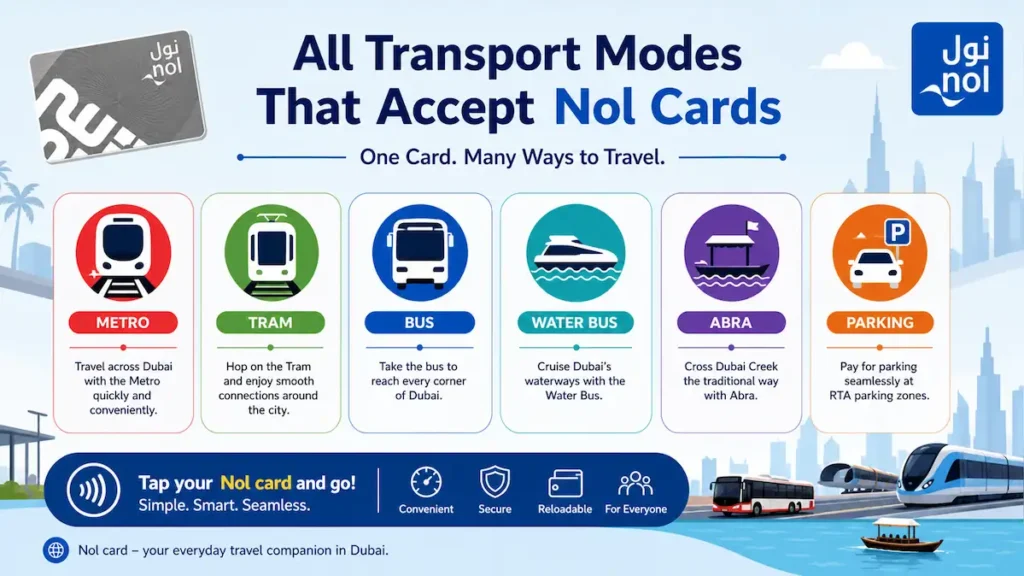
The nol card works across the entire RTA network. You can use it on the Dubai Metro (Red and Green Lines), the Dubai Tram, all public buses including intercity routes, water buses and abras, and even paid parking if you have a personalized card.
With the basics covered, let’s compare the four card types side by side so you can pick the right one.
Nol Card Types: Silver, Gold, Blue, and Red – Which One Is Right for You?
Dubai gives you four nol card choices. Three of them are right for someone. But only one is right for you.
Silver Nol Card
the Silver card is the default for a reason. It costs AED 25, but AED 19 of that is pre-loaded credit you can spend immediately. The effective cost of the card itself is just AED 6. It stays valid for five years.
Per-trip fares run from AED 3 for a single zone. Crossing three or more zones costs AED 7.50. The daily fare cap is AED 14: once you hit it, every additional tap is free until midnight. Silver also gives you access to monthly passes if your commute justifies one.
For anyone making more than a few trips total, this is your card. The AED 6 effective cost recovers itself in just a few journeys versus a Red Ticket.
Expert Tip: If you’re in Dubai for more than a couple of days, a Silver card’s per-trip savings over a Red Ticket cover the AED 6 effective cost.
Gold Nol Card
the Gold card costs the same AED 25 with AED 19 credit. Its five-year validity matches Silver. The difference is in what you pay per ride: fares double to AED 6, AED 10, and AED 15 depending on zones. The daily cap doubles too, at AED 20.
What you get for that premium is access to the Gold Class cabin. It’s a separate section at the front of each train with fewer passengers and more personal space. The question I get most often is whether Gold Class is actually worth it. I bought a Gold card for a month when my commute shifted to the Red Line during morning peak. At Burjuman, the Silver cabins were shoulder-to-shoulder while Gold had seats available.
But here’s the thing: outside peak hours, the Silver cabin was half-empty and I was paying double for no reason. I switched back to Silver and never missed the Gold cabin except between 7:30 and 9:00 AM.
Gold only makes financial sense if you consistently use that Gold Class cabin. Otherwise you are paying double for the same journey.
Expert Tip: Gold Class is only worth the double fare if you travel during peak hours when Silver cabins are packed.
Blue Nol Card (Personalized)
the Blue card is the only nol card that protects your balance. It is personalized with your photo and linked to your identity. If you lose it, RTA can block the card and transfer your remaining credit to a replacement. The standard card costs AED 70 with AED 20 pre-loaded credit: an effective cost of AED 50.
The real power of the Blue card is concession eligibility. Students enrolled in UAE-accredited institutions, seniors aged 60 and above, and People of Determination with a valid UAE disability card qualify for 50 percent off all fares and passes. That means per-trip fares drop to AED 1.50, AED 2.50, and AED 3.75. Monthly passes start at just AED 70.
Expert Tip: A Blue Concession card gives students, seniors, and people of determination 50% off all fares and passes: the single biggest saving available.
Red Ticket (Paper Card)
The Red Ticket is a disposable paper card that costs AED 2 with no pre-loaded credit. It expires after 90 days. Per-trip fares are higher than Silver: AED 4 for one zone, AED 6.50 for two, and AED 8.50 for three or more.
The Red Ticket offers only a daily pass at AED 20. Here is the trap: Silver’s daily cap is AED 14. Even on a heavy travel day, Silver costs less. I have watched tourists fumble with Red Tickets at busy gates while Silver card holders breeze through. The time saved alone is worth the AED 6.
The Red Ticket is best for exactly one scenario: you are in Dubai for one or two trips total and will never return.
Product Recommendation: Check the latest Red Ticket fares and daily pass options on the RTA website before buying, as prices can change.
Card in hand, the next thing to understand is how much each trip actually costs under the zone system.
Pay-As-You-Go Fares: How the Zone System Affects Your Trip Cost
The zone system is where most people get lost. It’s simpler than it looks, and getting it right is the difference between paying AED 3 and AED 7.50 for the same trip.
Understanding the 7-Zone System
Dubai is divided into seven transport zones. Your fare depends on how many zones you cross, not the distance you travel. A one-stop hop from Zone 1 into Zone 2 costs the same as a ten-stop ride that stays within those two zones. You must tap in and tap out every journey. Forget, and the system charges the maximum fare for your card type, even if you only crossed one zone.
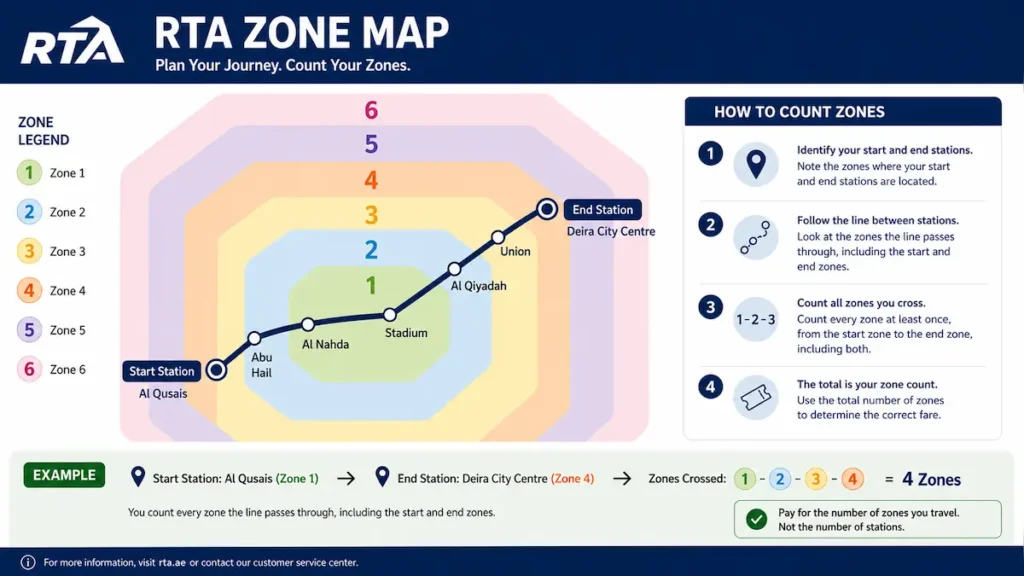
Expert Tip: Always tap in and tap out, even if gates are open, to avoid a maximum-fare penalty.
Fare Tiers for Silver, Gold, and Red Cards
The per-trip cost is set by card type and zones crossed. Silver and Blue cards charge AED 3 for one zone, AED 5 for two zones, and AED 7.50 for three or more zones. Gold cards double those amounts: AED 6, AED 10, and AED 15. Red Tickets cost AED 4, AED 6.50, and AED 8.50.
Daily Fare Caps and Free Transfers
The daily cap is the real budget tool. On a Silver or Blue card, you’ll never pay more than AED 14 in a single day. Gold caps at AED 20. Once you hit the cap, every extra trip until midnight is free.
AED 14. That’s the number that changed how I plan my week. I used to obsess over whether a trip was one or two zones, but once I saw the cap kicks in after just two 3-zone rides, I started batching errands on the same day. The afternoon trips cost nothing.
Expert Tip: After hitting the daily cap (AED 14 Silver, AED 20 Gold), all further rides are free. So batch your errands on heavy travel days.
The 30-minute free transfer rule turns bus-metro combos into a single fare. Tap from bus to metro within half an hour, and the system treats the whole journey as one trip, charging only for the total zones crossed. Miss that window, and you pay twice.
If you travel frequently, a monthly pass might beat pay-as-you-go: let’s look at the numbers.
Monthly Pass Prices: Unlimited Travel for 30 Days – All Zones and Card Types
Pay-as-you-go works for occasional riders. But if you’re on the metro twice a day, five days a week, a monthly pass might cut your costs. Here’s the math.
Monthly Pass Options by Zone Coverage
| Zone Coverage | Silver Card (AED) | Gold Card (AED) | Concession Card (AED) |
|---|---|---|---|
| 1 Zone | 140 | 280 | 70 |
| 2 Zones | 230 | 460 | 115 |
| All Zones | 350 | 700 | 175 |
Red Ticket doesn’t support monthly passes; you need a registered Silver, Gold, or Blue card. The 7-day pass (Silver all zones ~AED 110) is an alternative for short stays but rarely beats the monthly pass for longer visits.
How to Purchase a Monthly Pass
Buy a monthly pass at ticket vending machines, via the nol Pay app, at RTA Customer Service Centers, or on the RTA website (registered card required).
Product Recommendation: Use the nol Pay app for contactless pass purchases and top-ups without queuing at ticket machines.
Is a Monthly Pass Worth It? Quick Break-Even Check
Last January, I bought a Silver all-zone pass for a month I only commuted 15 times, expecting it to be the obvious choice. The math said otherwise: AED 350 vs. AED 112.50 pay-as-you-go. Always count your expected trips first. A monthly pass is cost-effective if you make more than 2 trips per day. For Silver all zones (AED 350), break-even is about 47 single trips at AED 7.50 each. A 5-day/week commuter making 44 trips/month comes close to breaking even; a few extra trips tip the scale.
Expert Tip: Check the official RTA zone map before buying a monthly pass, paying for extra zones you don’t need is a common and costly mistake.
To make the choice even clearer, here’s every card type and cost side by side in one table.
You’ve seen the pieces. Now see them all together: this is the comparison table most guides don’t give you.
During the 2024 Dubai Shopping Festival, I handed my visiting cousin a Red Ticket for a day of sightseeing. Four trips later (Union to Burj Khalifa, back to the hotel, then out to Dubai Marina) we’d spent AED 16 each.
That’s when I noticed the quiet differentiator nobody talks about: the Silver card’s daily cap of AED 14 would have stopped charging us after the third trip.
The Red Ticket’s low AED 2 entry price is a trap if you move around at all.
That day cost us more than a Silver card would have, and we didn’t even get the balance protection. That’s the kind of detail you only catch when you run the numbers yourself. Here’s the full side-by-side.
Nol Card Comparison: Side-by-Side Costs, Fares, and Best Use Cases
Comprehensive Comparison Table
| Card Type | Purchase Cost (AED) | Pre-loaded Credit (AED) | Per-Trip Fare Range (AED) | Pass Availability | Best For |
|---|---|---|---|---|---|
| Silver | 25 | 19 | 3 – 7.50 | Monthly pass (Silver) | Daily commuters, most residents |
| Gold | 25 | 19 | 6 – 15 | Monthly pass (Gold) | Comfort seekers, business travelers |
| Blue (Standard) | 70 | 20 | 3 – 7.50 | Monthly pass (Silver prices) | Balance protection, online top-up |
| Blue (Concession) | 70 (fee often waived) | 20 | 1.50 – 3.75 | Monthly pass (concession prices) | Students, seniors, People of Determination |
| Red Ticket | 2 | 0 | 4 – 8.50 | Daily pass only¹ | Tourists with very few trips |
¹ Red Ticket can be loaded with a daily pass for AED 20, but no monthly pass is available.
Card Type Deep Dive: Silver vs. Gold vs. Blue vs. Red
Silver is the workhorse. It gives you the lowest standard per-trip fares (AED 3–7.50) and a daily cap of AED 14. Once you hit that, every extra ride is free. For anyone commuting regularly, it’s the default winner.
Gold doubles your fare for a quieter cabin. Fares run AED 6–15 per trip, and the daily cap doubles to AED 20. You pay for comfort twice: once per trip and again at the daily limit. It’s a luxury, not a savings play.
Blue Standard costs AED 70 upfront but protects your balance if the card is lost or stolen. Per-trip fares are identical to Silver, so you’re paying extra for security and the ability to top up online. It’s worth it if you’ve ever lost a card with a full balance.
Blue Concession is the hidden gem. At 50% off everything, fares as low as AED 1.50 and monthly passes from AED 70, it’s the ultimate money-saver for students, seniors, and People of Determination. If you qualify, this card pays for itself almost immediately.
Red Ticket is only for the most infrequent users. Its AED 2 price is tempting, but after four trips you’ve already blown past Silver’s daily cap. Stick to one or two rides total; otherwise, Silver is cheaper.
Expert Tip: Register your Silver or Gold card online (free) to protect your balance if lost or stolen. Most people skip this.
Which Card for Tourists?
- 1–3 days, very few trips: A Red Ticket may suffice, but a Silver card becomes cheaper after four trips in a day. If you plan to move around at all, get Silver.
- 5–7 days of sightseeing: Silver with pay-as-you-go and the daily cap is the clear choice. You’ll hit the AED 14 cap quickly and ride free the rest of the day.
- Luxury traveler: Gold for the quieter cabin, but know you’re paying double for the privilege.
Which Card for Daily Commuters?
- Standard commuter: Silver. If you make two or more trips per day, evaluate a monthly pass. The break-even is surprisingly low.
- Concession-eligible: Blue Concession with a monthly pass gives you the lowest possible cost. The 50% discount applies to passes too, so a 1-zone pass is just AED 70.
- Comfort-seeker: Gold only if your budget allows. The fare difference adds up fast on a daily commute.
Now let’s walk through a simple decision framework to match a card to your exact travel pattern.
How to Choose the Best Nol Card or Pass for Your Travel Pattern
You know the cards and the prices. Now let’s run your numbers through a simple framework so you land on the cheapest option.
Decision Framework: Travel Frequency and Budget
Start by estimating your daily trips and the zones you cross. Multiply that by the pay-as-you-go fare for your card type, then cap it at the daily maximum. Compare that monthly total to the cost of a monthly pass for the same zone coverage. If you qualify for a concession, halve both numbers. The lower total monthly cost wins.
Most daily commuters who cross zones will find the pass pays for itself quickly, but if you only ride a few times a week, pay-as-you-go on a Silver card almost always comes out ahead.
Expert Tip: If you commute daily and cross zones, a monthly pass often pays for itself after around 10 round trips. Run the numbers before defaulting to pay-as-you-go.
Eligibility for Concession Cards
Students enrolled in UAE-accredited schools or universities, senior citizens aged 60+, and People of Determination with a valid UAE disability card all qualify for a Blue Concession card. That card slashes fares and pass prices by 50%. The application requires documents and can take several days, so start early. You can apply through the official RTA concession application page.
Hidden Costs to Consider
The upfront price tag hides real costs. A Silver or Gold card costs AED 25 but only AED 19 of that is usable credit. The effective card fee is AED 6. A standard Blue card has a AED 50 effective fee you’ll never get back.
Minimum top-up amounts and non-refundable balances on Silver and Gold cards can trap small sums. And the fines are brutal: AED 200 for tapping out with insufficient balance, using a Gold card in a Silver cabin, or forgetting to tap at all. Standing at the metro gate with a rejected beep, I realized the AED 7.50 minimum isn’t a suggestion. It’s a hard gate that can trigger a AED 200 fine if you can’t tap out.
Money-Saving Hacks
Bunch errands into a single day to hit the daily fare cap faster and ride free after that. Use the free 30-minute transfer window to combine trips without paying again. Skip the Red Ticket if you’ll make more than a couple of trips; its per-ride cost adds up fast. Check your balance regularly via the nol Pay app, and never let it dip below AED 7.50.
Expert Tip: Always keep at least AED 7.50 on your Silver or Blue card to avoid a rejected tap and a potential AED 200 fine for failing to tap out.
Once you’ve chosen your card, here’s exactly how to buy it and keep it topped up.
How to Buy and Top Up Your Nol Card: A Step-by-Step Guide
Enough theory. Here’s exactly where to go and what to press to get your card and keep it loaded.
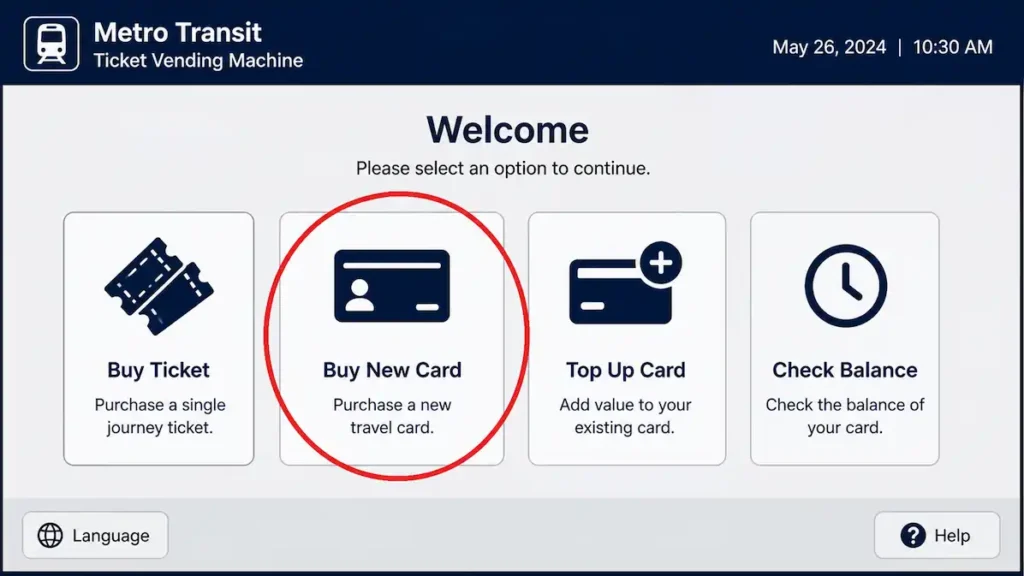
Buying a Nol Card at Metro Stations: Step-by-step
Locate a ticket vending machine (TVM) at any metro station. Select ‘Buy New Card’, then choose your card type: Silver, Gold, or Red. (Blue concession cards require a visit to a customer service center with your Emirates ID and proof of eligibility.) Pay the issuance fee: AED 25 for Silver/Gold (includes AED 19 credit) or AED 2 for a Red Ticket. The machine dispenses your card with pre-loaded credit.
Immediately register it via the nol Pay app or RTA website; unregistered cards cannot be blocked or refunded if lost.
Topping Up via Ticket Machines: Step-by-step
Tap your existing card on the reader, select ‘Top Up’, choose the amount, and pay. Cash top-ups reflect instantly. Card payments, however, may take up to 24 hours (as of publication) to appear on your balance. That delay can catch you out.
I’d never top up with a card at a TVM again. The one time I did, the balance didn’t show for hours, and I got hit with a maximum fare because I couldn’t tap out. Cash is instant; the app is even better.
Expert Tip: Top up via the nol Pay app while walking to the station. Your balance updates instantly, and you skip the ticket machine line.
Using the nol Pay App: Step-by-step
Download the nol Pay app, register, and add your card by scanning it or entering the number. Top up with a debit or credit card, or purchase a monthly pass. The balance loads instantly, and you can view your transaction history anytime.
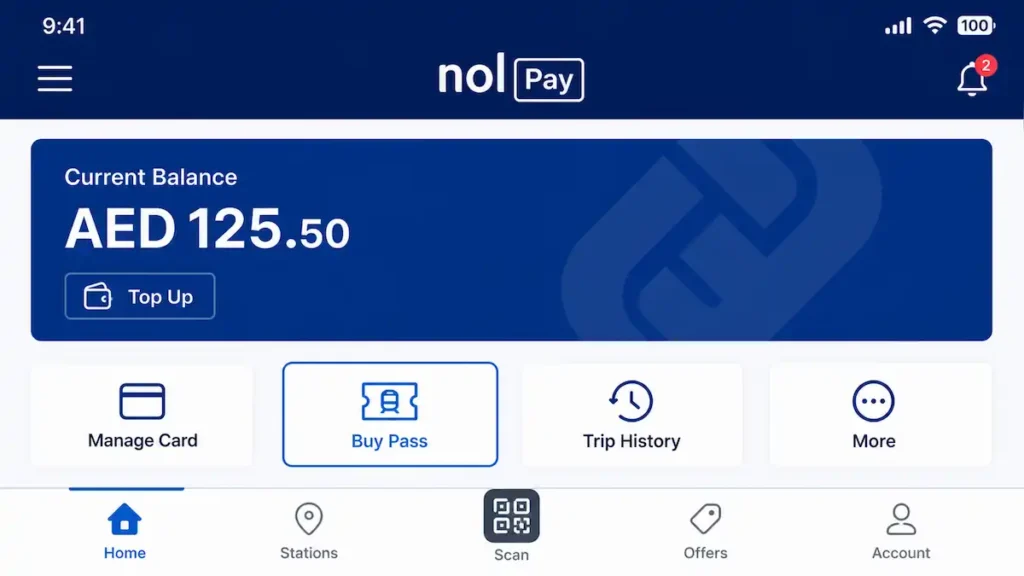
Product Recommendation: The nol Pay app is the fastest way to top up and buy passes, eliminating ticket machine queues entirely.
Purchasing a Monthly Pass Online: Step-by-step
Visit rta.ae, log into your nol account, and select ‘Purchase Pass’. Choose your zone coverage and duration, then pay online. The pass activates immediately or on a specified start date. You can also buy passes via TVMs and the nol Pay app. Remember: monthly passes are tied to a single card. If you replace your card, you must transfer the pass through customer service or lose it.
Let’s see how these choices play out in real life with three common scenarios.
Real-Life Cost Scenarios: How Much You’ll Actually Spend
Abstract prices don’t stick. Real scenarios do. Here’s what three very different people actually pay.
Scenario 1: Tourist Staying 5 Days, Profile: 4 trips/day, 2 zones each. Silver pay-as-you-go: AED 14/day (cap) × 5 = AED 70 + AED 6 effective card = AED 76. Red Ticket: AED 26/day × 5 = AED 130 + AED 2 = AED 132. Verdict: Silver saves AED 56.
A tourist making four 2-zone trips daily hits the Silver daily cap of AED 14 after just three trips. Over five days, that’s AED 70 in fares, plus the AED 6 effective card cost, for a total of AED 76. A Red Ticket, with no daily cap, costs AED 26 per day, AED 130 in fares plus AED 2 for the card, totaling AED 132. The Silver card saves AED 56.
Last winter, a friend visited for five days and used a Red Ticket for four 2-zone trips daily. The daily cap never kicked in, and by day five he’d spent AED 132. A Silver card would have cost him AED 76.
Scenario 2: Daily Commuter (Work 5 Days a Week), Profile: Zone 2 to Zone 5, 3 zones each way, 2 trips/day, 22 working days. Silver pay-as-you-go: AED 14/day (cap) × 22 = AED 308. Monthly pass all zones: AED 350. Verdict: pay-as-you-go cheaper by AED 42, but extra trips could flip it.
A commuter traveling from Zone 2 to Zone 5 (3 zones) twice a day hits the AED 14 daily cap every workday. Over 22 working days, that’s AED 308. The all-zones monthly pass costs AED 350, so pay-as-you-go is cheaper by AED 42. But the margin is thin.
Expert Tip: For a 3-zone commuter, just two extra trips per week beyond the work commute can make the all-zones monthly pass cheaper than pay-as-you-go.
Scenario 3: Occasional User (Weekend Trips Only), Profile: 2 trips every Saturday and Sunday, within 1 zone. Silver pay-as-you-go: AED 6/day × 8 days = AED 48/month. Monthly pass 1 zone: AED 140. Verdict: pay-as-you-go far cheaper; pass only makes sense above 46 trips/month.
An occasional user taking two 1-zone trips each Saturday and Sunday spends AED 6 per day. Over eight weekend days, that’s AED 48 a month. The 1-zone monthly pass costs AED 140, nearly three times as much. You’d need 46 trips a month to break even, so pay-as-you-go is the clear winner.
Those scenarios hint at the break-even question: let’s formalize it with a simple formula and table.
Break-Even Analysis: When Does a Monthly Pass Save You Money?
The break-even point is the single most important number in this guide. Here’s how to calculate yours.
Break-Even Formula
The math is simple: divide the monthly pass price by your single trip fare. That gives you the number of trips you need to take before the pass saves you a single dirham.
Break-even trips per month = Monthly pass price ÷ Single trip fare
For a Silver all-zones pass (AED 350) and a AED 7.50 fare, that’s 350 ÷ 7.50 = 46.67 trips. Round up: you need 47 trips to break even. Gold passes double both fare and pass price, so the break-even stays the same. Concession pass holders break even at half the trips: a Blue all-zones pass at AED 175 needs just 24 trips.
Break-Even Table for Common Commutes
Most commuters assume a monthly pass is the obvious choice. The table below tests that assumption for a standard 5-day workweek: 2 trips a day, 22 working days, 44 trips a month. All figures use a Silver card.
| Zone Coverage | Monthly Pass Price (AED) | Single Trip Fare (AED) | Break-Even Trips | Trips per Month (22 days × 2) | Pass Worth It? |
|---|---|---|---|---|---|
| 1 Zone | 140 | 3 | 47 | 44 | No |
| 2 Zones | 230 | 5 | 46 | 44 | No |
| All Zones | 350 | 7.50 | 47 | 44 | No |
The numbers are blunt: on a strict 5-day commute, no Silver pass breaks even. You’d need to add a few weekend trips or an extra errand each week to tip the scale. I tracked my own all-zones commute for a month and came up 3 trips short. The pass would have cost me AED 50 more than pay-as-you-go. That’s the part nobody warns you about.
When a Monthly Pass Is Not Worth It
Skip the pass if any of these apply:
- You average fewer than 2 trips a day. Even a single missed commute day drops you below break-even.
- Your travel is irregular: freelancers, shift workers, and hybrid remote employees rarely hit the required trip count.
- You’re eligible for a concession (Blue) card but haven’t applied. A Blue pass halves the break-even, so not having it means you’re overpaying on every trip.
- You mostly move within one zone using multiple modes. The daily cap of AED 14 often kicks in before a pass would, especially if you chain bus, tram, and metro trips.
Expert Tip: If you’re unsure, start with pay-as-you-go for a month, track your trips, and then calculate whether a pass would have saved you money.
Beyond fares and passes, there are hidden costs that can blow your budget. Let’s expose them.
Hidden Costs and Money-Saving Hacks: What RTA Doesn’t Tell You
The fare table tells half the story. These are the costs that catch everyone off guard, and the hacks that turn the system in your favor.
Card Issuance Fees and Minimum Top-Ups
The sticker price on a nol card hides the real cost. A Silver or Gold card costs AED 25, but AED 19 of that is pre-loaded credit, so the effective card fee is just AED 6. The Blue standard card costs AED 70 with AED 20 credit, leaving a non-refundable AED 50 fee. The Red Ticket is AED 2 with no credit, cheap but disposable.
For a week-long stay, the Red Ticket wins. Stay longer, and the Silver card’s AED 6 fee is trivial.
Then there is the minimum top-up. Some ticket machines require a minimum top-up of around AED 10, so you cannot just add AED 5 to scrape by. And before you even tap in, your card must hold the minimum journey balance: AED 7.50 for Silver and Blue, AED 15 for Gold. Drop below that and the gate rejects you instantly. No warning, no grace.
Fines for Insufficient Balance or Wrong Card Usage
RTA fines are steep and automated. The big one: AED 200 for not tapping in or out. Even if the gates are open, the system assumes you rode the entire network and charges the maximum fare. Using a Gold card in a Silver cabin also triggers a AED 200 fine, and traveling without a valid card is the same penalty.
Insufficient balance can trap you: if you tap in with enough credit but cannot tap out because a transfer pushed you below the minimum, you may face a fine.
How to Avoid Paying Maximum Fare
Always tap in and out, even if the gates are wide open. A missed tap at either end triggers the maximum fare charge. If you are charged incorrectly, say a tap did not register, dispute it at a customer service center or through the nol Pay app. Check your nol card balance before traveling; the app shows it in real time, so you never get caught short at the gate.
Daily Cap Hack: Maximize Free Rides
I assumed the daily cap was a safety net for heavy users, but it’s a free-ride engine. Once you hit AED 14 on a Silver card (or AED 20 on Gold), every tap after that is free until midnight. I started bunching my grocery run and gym visit right after my commute. The commute already pushed me near the cap, so the evening errands rode free. That’s an extra AED 10 or more saved per day, and it adds up fast.
Expert Tip: Hit the daily fare cap early by bunching errands after your commute. All subsequent rides are free until midnight.
Concession Card Savings: Are You Eligible?
Half-price travel is hiding in plain sight. Students at UAE-accredited institutions, residents aged 60+, and People of Determination with a valid UAE disability card qualify for the Blue Concession card, which slashes all fares and passes by 50%. Many residents never check, assuming the process is complicated. It is not.
Visit an RTA Customer Service Center with your documents, and they handle the application in person. The card fee is often reduced or waived entirely.
Product Recommendation: RTA Customer Service Centers can process concession card applications in person, often with reduced or waived card fees.
You probably still have questions. Here are the answers to the most common ones.
About the Author
This guide wasn’t written from a desk. It was written from years of tapping in and out. Forty taps a month, and the card still read “Silver”. That’s when I knew I’d been bleeding dirhams. I’ve since tested every nol card and pass on my own commute, so the break-even math here isn’t theory; it’s what I wish someone had handed me years ago.
And finally, our sources and disclaimer.
Sources and Disclaimer
Transparency matters. Here’s where every number came from, and the one disclaimer you need.