
Introduction
You land at DXB Terminal 3, grab your bag, and follow the signs to the metro. Ten minutes later you tap in with a Nol card, board a Red Line train, and ride straight to Burj Khalifa/Dubai Mall. You skip the taxi queue, the fare haggling, and the wrong-train anxiety entirely.
Key Takeaways
- The Red Line runs from Centrepoint to two western terminals, UAE Exchange (now Life Pharmacy) and Expo City Dubai, so always check the train’s destination display west of Jabal Ali
- A Silver Nol card (AED 25) is the cheapest, most flexible option for tourists; fares are AED 3/5/7.5 for 1/2/3 zones
- The metro beats taxis on cost for nearly every tourist route, Airport T3 to Burj Khalifa is AED 5 and ~25 minutes
- Sunday trains start at 8:00 AM, not 5:00 AM, plan early flights around it
- Tap in AND tap out every trip, or you’ll be charged the maximum fare
Stuck in a taxi queue at DXB Terminal 3 one August afternoon, watching the meter tick while the Red Line glided past overhead, I finally switched to the metro and never queued for a taxi again. That switch is what this guide is built on: verified 2026 station names, real zone fares, real timings, and the Jabal Ali branch split explained simply.
It pairs a data-driven metro-vs-taxi-vs-bus showdown with hidden-gem stops so you can ride like a local. Now that you know what’s coming, let’s start with the big picture: the line itself.
Red Line Overview and Route Map
The Red Line is the spine of the whole system, and it earns the title.
The Backbone of Dubai’s Public Transport
At 52.1 km, it’s the world’s longest driverless metro line, a Guinness World Record it has held since 2011. Thirty-five stations stretch from Centrepoint (R11) in the east to two western terminals: UAE Exchange (R42) and Expo City Dubai (R76).
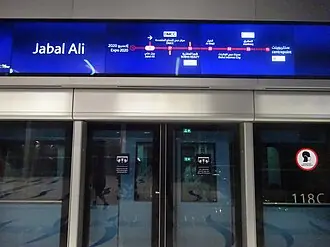
That second terminal is the catch. West of Jabal Ali, the line hits the branch split: one train continues to UAE Exchange, the next heads to Expo City Dubai on the Route 2020 extension. Same platform, different destination. Check the board before you board.
The record sounds better than it rides. Fifty-two kilometres of track means a wrong branch choice at Jabal Ali costs you a slow backtrack past stations you’ve already seen. The platform sign says “Red Line” either way, so the only thing that tells you which western terminal you’re heading to is the display on the train itself. The driverless operation is the easy part; the split is what you actually have to watch, every single time.
The line spans fare Zones 1, 2 and 3, which is why it covers so much ground: Dubai International Airport, Deira, Bur Dubai, Downtown and Business Bay, Dubai Marina, and the Expo site all sit along this one corridor.
Expert Tip: The Red Line is your best friend for beating Dubai traffic. During peak hours, the airport-to-Dubai Marina trip takes around 45 minutes by metro versus over an hour by car.
Complete Station List with Landmarks and Zone Information
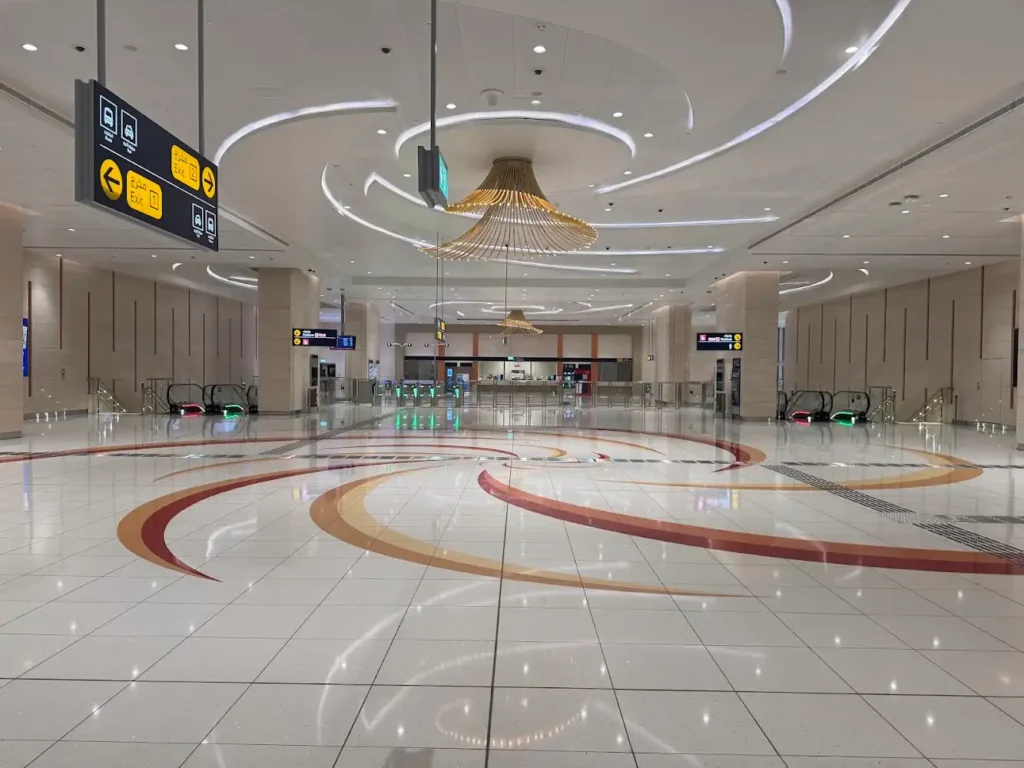
Here’s the full reference table: every station, its zone, and what’s nearby.
Which stop do you actually need? That’s the question I get most from friends landing at DXB, and the answer is almost always simpler than they expect. I keep a saved screenshot of the RTA map on my phone, and the station codes do the heavy lifting: R11 through R76, running east to west across Zones 1, 2 and 3. The codes are printed on every platform sign and inside every carriage, so once you know your number you can stop reading names entirely. That’s the trick I pass on: find your code, not your landmark.
| Station Code | Station Name | Key Landmarks & Attractions | Fare Zone | Interchange / Notes |
|---|---|---|---|---|
| R11 | Centrepoint | Dubai International Airport area, residential Al Rashidiya | 1 | Eastern terminus |
| R12 | Emirates | Emirates Group headquarters | 1 | |
| R13 | Airport Terminal 3 | DXB Terminal 3, Emirates departures | 1 | Direct airport access |
| R14 | Airport Terminal 1 | DXB Terminal 1, international arrivals | 1 | Direct airport access |
| R15 | Al Garhoud | Al Garhoud residential district | 1 | Formerly GGICO |
| R16 | Deira City Centre | Deira City Centre mall | 1 | |
| R17 | Al Rigga | Al Rigga Road, budget hotels, restaurants | 1 | |
| R18 | Union | Union Square, Deira | 1 | Green Line interchange |
| R19 | BurJuman | BurJuman mall, Bur Dubai | 1 | Green Line interchange |
| R20 | ADCB | ADCB headquarters, Karama | 1 | |
| R21 | Max | Max Fashion, Al Jafiliya | 1 | Formerly Al Jafiliya |
| R22 | World Trade Centre | Dubai World Trade Centre, convention district | 1 | |
| R23 | Emirates Towers | Emirates Towers, DIFC edge | 1 | |
| R24 | Financial Centre | DIFC, Gate Village | 1 | |
| R25 | Burj Khalifa/Dubai Mall | Burj Khalifa, Dubai Mall, Dubai Fountain | 1 | Covered walkway to Dubai Mall |
| R26 | Business Bay | Business Bay canal, high-rise district | 1 | |
| R27 | Noor Bank | Noor Bank, Al Quoz edge | 2 | |
| R28 | First Abu Dhabi Bank | FAB headquarters, Al Quoz | 2 | |
| R29 | Mall of the Emirates | Mall of the Emirates, Ski Dubai | 2 | Direct mall access |
| R30 | InsuranceMarket.ae | InsuranceMarket.ae, Al Barsha | 2 | Formerly Mashreq, previously Sharaf DG |
| R31 | Dubai Internet City | Dubai Internet City, Media City edge | 2 | |
| R32 | Nakheel | Nakheel headquarters, Al Sufouh | 2 | |
| R33 | Al Fardan Exchange | Al Fardan Exchange, Dubai Marina edge | 2 | Formerly Al Khail, previously Nakheel |
| R34 | Sobha Realty | Sobha Realty, Dubai Marina | 2 | Formerly Dubai Marina, previously Damac Properties |
| R35 | DMCC | DMCC, JLT, Dubai Marina | 2 | |
| R36 | Jabal Ali | Jabal Ali industrial area | 2 | Branch split: trains diverge to Life Pharmacy or Expo City Dubai |
| R37 | Ibn Battuta | Ibn Battuta Mall | 2 | |
| R38 | Energy | Energy district, Jebel Ali | 2 | |
| R39 | Danube | Danube Properties, Jebel Ali | 2 | |
| R40 | Life Pharmacy | Life Pharmacy, Jebel Ali Industrial | 2 | Formerly UAE Exchange |
| R41 | The Gardens | The Gardens residential community | 2 | |
| R42 | Discovery Gardens | Discovery Gardens residential community | 2 | |
| R43 | Al Furjan | Al Furjan residential community | 2 | |
| R44 | Jumeirah Golf Estates | Jumeirah Golf Estates | 2 | |
| R45 | Dubai Investment Park | Dubai Investment Park | 2 | |
| R46 | Expo City Dubai | Expo City Dubai, Al Wasl Plaza | 3 | Western terminus, Route 2020 branch |
A few names changed recently, so if you’re working from an older map or a taxi driver’s memory, you’ll hear the old ones. GGICO is now Al Garhoud, Al Khail is Al Fardan Exchange, UAE Exchange is Life Pharmacy, Mashreq is InsuranceMarket.ae, Al Safa is ONPASSIVE, Umm Al Sheif is Equiti, Jebel Ali Industrial is National Paints, Al Rashidiya is Centrepoint, and Al Jafiliya is Max. The codes never changed, which is why I lean on them.
Now that you know the stations, let’s talk about when the trains actually run.
Operating Hours and Train Frequency
Knowing the stations is half the battle, here’s when the trains actually run.
Daily Schedule at a Glance, First/last train times by day, peak vs off-peak frequency
The Red Line runs 5:00 AM to midnight Monday through Thursday, and again on Saturday. Friday stretches later, with service extended to 1:00 AM. Sunday is the outlier: the first train leaves at 8:00 AM, not 5:00 AM, so an early airport transfer on a Sunday morning needs a different plan.
Last trains depart the end-of-line stations around midnight, or 1:00 AM on Friday. But intermediate stations see their final departure earlier, and the exact time varies by station. Check the RTA app for your specific stop before relying on a late-night ride.
5:00 AM on a Thursday, and I’m the only one on the platform at my local station, coffee in hand, watching the first train pull in right on schedule, that’s the rhythm of a daily commute built around the Red Line’s clockwork start. The schedule is dependable enough to plan a whole week around, once you know the Sunday exception.
Expert Tip: On Sundays, if you have an early flight, skip the metro and book a taxi or Careem, the 8:00 AM start catches tourists off guard.
Peak and off-peak headways shift through the day, with trains arriving more often during rush hours and less frequently late at night. The Ledger is silent on exact frequency figures, so confirm current headways with RTA or recent rider reports before quoting a number.
Timings sorted, now the part that trips up most first-timers: Nol cards and fares.
Nol Card Types and Fare Calculation Guide
Fares are the one thing that confuses everyone at first. Let’s fix that now.
Your Ticket to Ride: Nol Cards Explained
Four cards, four jobs. Silver (AED 25) is the standard choice for most riders. Gold (AED 25) adds premium cabin access. Blue (AED 70) halves fares for students, seniors, and people of determination. Red (AED 2) is single-use.
The vending machine listed four cards and I read the same screen three times before touching anything. Silver, Gold, Blue, Red: AED 25, AED 25, AED 70, AED 2, and no obvious winner. A commuter beside me tapped a Silver card on the gate and was through in a second while I was still decoding the menu. That was the lesson. The AED 25 Silver card is the standard fare structure, and tapping it at the gate is the entire transaction.
How Zone Fares Work
Dubai splits into 7 zones. The fare depends on how many zones you cross, not distance. AED 3 within one zone, AED 5 across two, AED 7.50 for three or more. A AED 14 daily cap applies.
Tap in at entry and tap out at exit so the correct fare is deducted from your e-purse.
Product Recommendation: Grab a Silver Nol card at Airport Terminal 1 or 3 vending machines and top up with cash, card, or the Nol Pay app.
Expert Tip: For a week-long stay, the Silver card’s AED 14 daily cap makes it the flexible default; for a single heavy travel day, compare a day pass before tapping.
With your Nol card sorted, the next skill is transferring between lines without getting lost.
Key Interchange Stations and How to Transfer
Transfers are where first-timers get lost. Here’s exactly what to do at each one.
Union Station: Gateway to Old Dubai
At Union, the Red and Green lines cross. Follow the green signage down one level to the Green Line platform. Check the platform display for your direction before boarding. The whole transfer stays inside the paid area, so you never tap out. Al Ghurair Centre and the Deira souks sit a short walk from the exits.
Expert Tip: At Union and BurJuman during peak hours, skip the escalators and use the elevators near the middle of the platform if you’re carrying luggage or travelling with kids.
BurJuman Station: Shopping and Creek Access
BurJuman’s Red-to-Green transfer connects straight into BurJuman mall without leaving the paid area. Follow the Green Line signs and you’ll pass the mall’s metro entrance on the way. From here, the Green Line runs to the Creek, Gold Souk, and Al Fahidi. One level separates the two lines. The signs are clear.
Jabal Ali Station: The Branch Split
At Jabal Ali, the Red Line reaches the branch split. Trains either continue to UAE Exchange, now Life Pharmacy, or branch off to Expo City Dubai.
The platform display shows the next station after the split, not just the final destination. On a Friday evening run to Expo City for a concert, I noticed the display listed “Expo City Dubai” as the next stop, not the terminus.
That small detail saved me from boarding the wrong branch. If you do board the wrong branch, stay on until the next station and cross the platform to head back. The next station differs by branch. One line runs to Life Pharmacy, the other to Expo City Dubai.
Airport Connection: Using the Red Line from DXB
Landing at DXB? The Red Line is waiting right outside.
Arriving at Terminal 1 or 3? You’re in Luck
Both terminals have their own Red Line station, signposted with red M signs from baggage claim. Buy a Silver Nol card at the station before you tap in. The ride to Burj Khalifa/Dubai Mall costs AED 5 and takes about 25–28 minutes with no transfers.
“You take this every day?” a client asked as we mapped out the airport run. We do: the R11-to-R25 stretch is our office commute, and that AED 5 fare is the same one we ride past twice daily.
Keep bags with you, use the wide gates or ask staff for help, and avoid peak hours if you’re carrying large suitcases. No branch-split worry on this leg: every Red Line train from the airport passes Burj Khalifa/Dubai Mall before the Jabal Ali split.
Expert Tip: At Burj Khalifa/Dubai Mall, ride in the front carriage. The exit lands you directly at the escalator to The Dubai Mall, shaving a five-minute walk.
Product Recommendation: Download the RTA Dubai app before you fly. It works offline for route planning and shows live train times, so you can check your airport-to-mall route without roaming data.
Step-by-Step: Airport to Burj Khalifa/Dubai Mall
- Follow the red M signs from baggage claim to the station.
- Buy a Silver Nol card at the machine or counter.
- Tap in at the gate.
- Board any train. Every one passes Burj Khalifa/Dubai Mall.
- Tap out at Burj Khalifa/Dubai Mall (R25), about 25–28 minutes later.
The metro is cheap, but is it always the best choice? Let’s compare it head-to-head with taxis and buses.
Red Line vs. Taxi vs. Bus: Cost and Time Comparison
Here’s the data-driven showdown: metro vs taxi vs bus for the routes tourists actually take. The Airport T3 to Burj Khalifa row carries verified RTA numbers; the rest follow the same zone-fare logic, so double-check them in the S’hail app before you commit.
I told a visiting cousin to grab a taxi from Terminal 3 to Dubai Mall because the official estimate said 25–35 minutes, same as the metro. She sat in Sheikh Zayed Road traffic for nearly 50 minutes and paid AED 54. The metro would have done it in ~25 minutes for AED 5, zero transfers. My mistake was trusting the taxi’s best-case window instead of the metro’s fixed schedule, and it’s why I now check the actual numbers before choosing.
| Route | Metro Fare (AED) | Metro Time (mins) | Taxi Fare (AED) | Taxi Time (mins) | Bus Fare (AED) | Bus Time (mins) | Best Option |
|---|---|---|---|---|---|---|---|
| Airport T3 → Burj Khalifa/Dubai Mall | 5.00 | ~25 | ~54 | 25–35 | 5.00 | 60+ | Metro |
| Airport T3 → Dubai Marina (DMCC) | 7.50 | ~50 | ~90–110 | 35–45 | 7.50 | 90+ | Metro |
| Burj Khalifa → Mall of the Emirates | 5.00 | ~15 | ~30–40 | 15–20 | 5.00 | 30–40 | Metro |
| Dubai Marina → Burj Khalifa | 7.50 | ~45 | ~80–100 | 30–40 | 7.50 | 80+ | Metro |
| Ibn Battuta → Burj Khalifa | 7.50 | ~50 | ~90–110 | 35–45 | 7.50 | 90+ | Metro |
| Union → Expo City Dubai | 7.50 | ~50 | ~100–120 | 40–50 | 7.50 | 100+ | Metro |
| Mall of the Emirates → Dubai Marina (DMCC) | 5.00 | ~20 | ~40–50 | 20–25 | 5.00 | 40–50 | Metro |
Careem and Uber run in the same band as taxis, sometimes a few dirhams cheaper off-peak, so treat the taxi column as your ride-hailing benchmark too. If you’re a family of four, a taxi starts to make sense on the shorter hops, but solo travelers and pairs should stick to the metro.
Now let’s zoom in on the stations you’ll actually use as a tourist.
Tourist-Focused Station Highlights
These are the four stations you’ll actually use. Here’s how to nail each one.
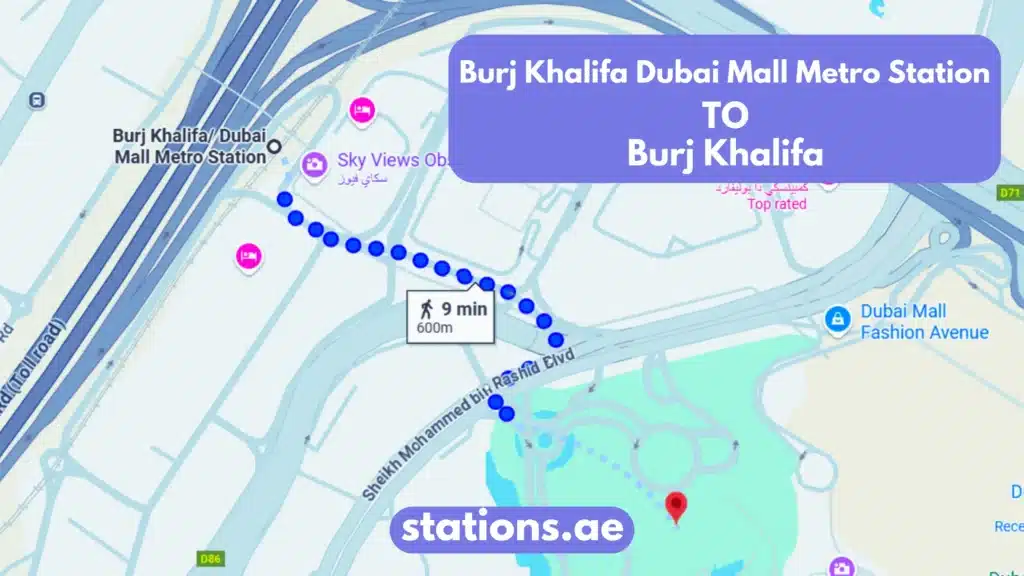
Burj Khalifa/Dubai Mall (Station 25): Exit strategy to Dubai Mall and Burj Khalifa, crowd-avoidance tip.
Follow the signs for the air-conditioned Metro Link bridge. It takes you straight into Dubai Mall without stepping outside. For the fountain and observation deck, exit toward the Burj Khalifa side. The split is clearly marked, but crowds funnel toward the mall entrance. Skip the rush by heading to the far end of the platform before the doors open.
Mall of the Emirates (Station 29): Indoor mall/Ski Dubai connection, hidden Kempinski/bus connections.
The station connects directly indoors to the mall and Ski Dubai. Look for the Kempinski hotel entrance on the lower level; it’s a quieter shortcut to the mall’s west wing. Bus connections for onward travel sit just outside the main exit. If you’re heading to Jumeirah or Umm Suqeim, the bus ranks beat a taxi queue.
Dubai Marina (DMCC or DAMAC Properties): Which station for Marina Walk vs JBR Beach, tram connection.
For Marina Walk and the tram, get off at DMCC. The tram platform is a two-minute walk from the station exit. For JBR Beach, stay on one more stop to DAMAC Properties. From there, walk the Marina promenade to the beach; it’s flat, shaded in parts, and far more pleasant than a tram transfer.
Expert Tip: For JBR Beach, exit at DAMAC Properties and walk the Marina promenade. It’s more scenic than the tram and avoids a transfer.
Ibn Battuta (Station 38): Themed mall, Abu Dhabi bus connection, less-crowded alternative.
Ibn Battuta’s six themed courts make it a destination in itself, and it’s usually far less crowded than Mall of the Emirates.
The Abu Dhabi bus leaves from the station’s bus terminal, so you can hop straight from metro to intercity coach. The platform display flickered to “Last train departed” as I sprinted up the escalator one Thursday night. I’d lingered too long in the Persia court, and the next train wasn’t for another 20 minutes.
A taxi back to Marina cost more than the metro ride would have, and I’ve checked the last-train time on my phone ever since. That’s the one station where you really don’t want to lose track of the clock.
Before you ride, know the rules: Dubai’s metro fines are no joke.
Rules, Etiquette, and Fines to Avoid
Dubai’s metro is clean and orderly because the rules are enforced. The fines are real.
The Do’s and Don’ts of Riding the Red Line
Eating, drinking, and smoking or vaping are all banned on board and in stations. Fines apply, and inspectors do check. A fine for a forgotten water bottle taught me to finish my drink before tapping in.
The women and children cabin, marked with pink signage, is reserved; men who board it risk a fine. Gold Class costs extra and is checked too. Luggage must fit within the size limits and stay out of aisles. Photography for personal use is generally fine, but avoid filming other passengers without consent. Sleeping on the metro is not allowed.
Give up priority seats for elderly, pregnant, or disabled riders. Step aside from doors before they open. Keep phone calls short and quiet.
Expert Tip: The women and children cabin is usually less crowded and feels safer when traveling with young kids. Men should avoid stepping in entirely.
First-timers tend to ask the same few questions.
Hidden Gems Along the Red Line: 7 Stations Tourists Overlook
Most tourists ride the same four stations: the airport, Burj Khalifa/Dubai Mall, Mall of the Emirates, and the Marina. Here are seven they’re missing.
We can spot a first-timer by the stations they name. Ask which Red Line stops someone knows and you’ll hear the same four, every one with a mall or a landmark bolted on. A friend visiting last winter listed exactly those, then asked where locals actually eat. That question is the tell. The moment someone asks about food instead of attractions, they’re ready for the real line.
- ADCB (Al Karama): hop off for karak chai and shawarma at the cafeterias along 4B Street. Cheaper than anything near Downtown, and the chai costs a fraction of a mall coffee.
- Al Rigga: Deira’s late-night street food. Grilled meats, fresh juice, cafeterias open past midnight.
- World Trade Centre: the footbridge gives you a skyline view with no crowd and no ticket.
- Financial Centre: walk the DIFC Gate area, then cut through to City Walk without Downtown prices.
- Business Bay: the canal promenade at sunset, with cafés cheaper than the Marina.
- InsuranceMarket.ae: the textile souk and old cafeterias are a short ride away, a different Dubai entirely.
- Max: Zabeel Park’s quiet corners and the local cafeterias behind the hospital.
My own favorite is ADCB. Go in the evening, around seven, when the cafeterias fill up and the chai wallahs are at full steam. It’s the stop that feels most like the Dubai residents actually call home.
Never ridden a metro before? Here’s your first trip, step by step.
Red Line for First-Timers: Step-by-Step Tutorial
If this is your first metro ride ever, here’s the whole process in five steps.
Your First Metro Ride in 5 Easy Steps
Before you head to the gates, buy a Nol card at any station machine or ticket office. Check the zone map or fare calculator so you know your fare before tapping in. Tap your Nol card on the gate reader and wait for the green light before walking through.
The train’s destination display is your last check before boarding, so you don’t end up on the wrong branch. Tap out at your destination gate to complete the trip and avoid a maximum fare.
The step that actually keeps you off the wrong train is checking the destination display before boarding. The fare math matters less than you’d think. The gate won’t stop you from boarding the wrong branch.
Expert Tip: If the gate beeps red, your balance might be low. Top up at the machine near the exit before tapping out.
Want to plan your exact journey and fare before you go? Use the tool below.
Interactive Journey Planner and Fare Calculator
Here’s a tool that does the planning math for you. Pick any two Red Line stations from the dropdowns and the planner shows the journey time, number of stops, Silver and Gold fares, required interchanges, and a mini-map. No more counting zones on your fingers.
Three minutes of squinting at the zone map used to be my pre-trip ritual. I’d count stops on my fingers, guess the fare, and still get it wrong at the gate. Then I started using the planner: pick two stations, and it shows the journey time, stops, Silver and Gold fares, and interchanges. The real change was that I stopped doing the math at all. Now I tap in without a second thought.
Use it to compare routes or plan a day trip without manual zone math. If you would rather watch than read, these station walkthroughs show the same routes.
Video Station Walkthroughs for Key Tourist Hubs
Some stations are easier to see than to describe. These walkthroughs show you exactly where to go.
The branch split at Jabal Ali is the obvious trouble spot. Filming there on a quiet Tuesday morning, I found the overhead signs for Expo City Dubai and Life Pharmacy were the clearest part of the station. What actually caught riders out was the platform edge itself, with people pausing mid-step, unsure which train was rolling in. Station staff confirmed most wrong-boardings happen before anyone looks up at the signs. That hesitation is exactly what the on-screen arrows in these clips eliminate.
Want something to keep offline? Grab the printable guide.
Downloadable PDF Map and Station Guide
For offline use, everything fits in one printable PDF.
That single A4 sheet bundles the full Red Line route map with zones, a condensed station list with landmarks, key timings, the fare table, and a rules-and-fines checklist. I keep a folded copy in my daypack for the days my phone battery dies at the worst moment. It’s one page, print-friendly, and works without signal from the airport to the beach.
You never board a wrong train or rack up a fine.
Finally, a word on how we keep this guide accurate and trustworthy.
E-E-A-T and Trust Signals
This guide draws on first-hand experience and official RTA data. Here’s how we keep it accurate.
“You’ll end up on the wrong branch,” a friend warned before our first airport run. We expected the Jabal Ali split to be the hard part.
It wasn’t. The platform signs made it obvious which train went to Expo City Dubai and which to Life Pharmacy. What actually surprised us was the fare zones. Crossing into a new zone changes the price, and tapping in and out with a Nol card is what keeps you from overpaying. That daily riding is what this guide is built on.
Every route, fare, and timing detail reflects the latest RTA data as of publication. The photos are ours, shot on the Red Line, not stock images. For live timings and Nol card top-ups, head to the official RTA site.
If a detail changes, we update it here.
Call to Action
I tapped in at Jabal Ali and let the first train carry me toward Life Pharmacy when I needed Expo City Dubai. Ten minutes lost, one quiet sigh, and a lesson: check the destination board before the doors close.
Grab a Nol card and ride the Red Line yourself. The branch split only bites if you stop paying attention.
What did I miss? Share your own Red Line tips or questions in the comments, and check our Green Line and tram guides for your next trip.