Introduction
The train pulled away from Jabal Ali and I watched the platform slide left while my car curved right, toward Expo, the wrong terminus. I’d checked the line color, not the destination display. That was the last time I trusted color over the overhead sign.
The RTA brochure tells you the Dubai Metro is clean, air-conditioned, and covers the city. All true, and all useless when you’re standing at the wrong platform watching your train split in two directions. This guide teaches the metro the way a daily rider knows it, not the way the brochure sells it.
You’ll learn to dodge the three traps that cost newcomers time and money: fare traps that overcharge you for a careless tap, timing traps that strand you past the last train, and exit mistakes that dump you on the wrong side of Sheikh Zayed Road with a fifteen-minute walk back.
Ride with the confidence of a local, pay exactly what you owe, and never get stranded.
Key Takeaways
- Two lines run now (Red and Green); Blue opens 2029 and Gold was announced in 2026, adding 72 km and 32 stations.
- A Silver Nol card (AED 25) is the cheapest flexible option for most tourists; fares are AED 3, 5, or 7.50 by zones crossed.
- Doors open 5:00 AM to midnight most days, but last trains leave earlier; Friday runs to 1:00 AM, Sunday starts at 8:00 AM.
- The Red Line splits west of Jabal Ali. Check the destination display before boarding or you’ll end up at the wrong terminus.
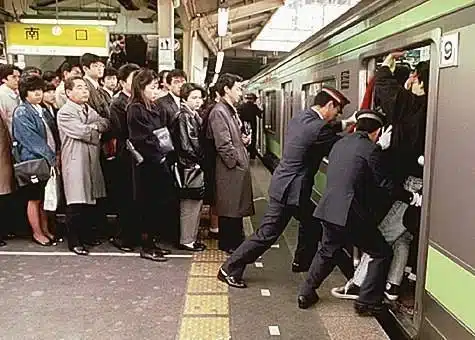
- Peak hours (7:00 to 9:00 AM, 5:30 to 7:30 PM) are crush-loaded; shifting your trip by 30 minutes is the difference between a seat and a sardine can.
The rest of this guide builds the mental model of the network, trap by trap.
The Dubai Metro Network at a Glance
Before you tap in, you need the map in your head.
Two Lines Today, Four by 2029
The Red Line is the backbone: 35 stations running the length of the city along the Sheikh Zayed Road corridor, from the airport down to the southern branches. The Green Line adds 20 stations through the older, denser neighborhoods of Deira and Bur Dubai. That gives you 55 stations across two lines today.
Two more lines are coming. The Blue Line, 30 km with 14 stations, opens September 9, 2029, serving one million residents and cutting road congestion by an estimated 20%. Then there’s the Gold Line: 42 km with 18 stations, approved April 22, 2026, backed by an investment of around AED34 billion. By the end of the decade, this network will look very different.
| Line | Route | Stations | Status |
|---|---|---|---|
| Red | Sheikh Zayed Road corridor, airport to southern branches | 35 | Active |
| Green | Deira, Bur Dubai, historic core | 20 | Active |
| Blue | East Dubai, connecting Red and Green corridors | 14 | Opens September 9, 2029 |
| Gold | 42 km expansion across new corridors | 18 | Approved April 22, 2026 |
Reading the Map
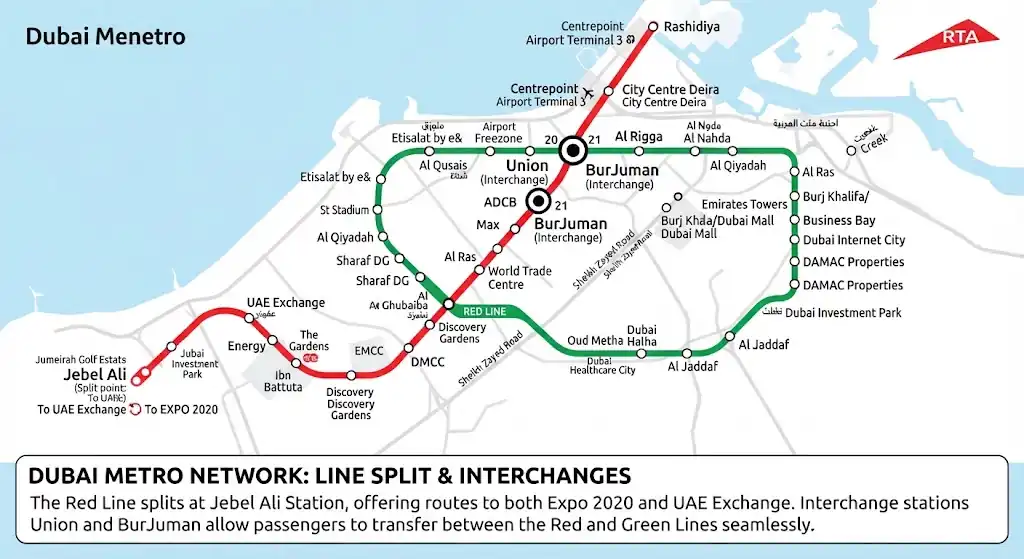
The map looks simple until you board the wrong train. Two traps catch new riders: the Jabal Ali branch split and the assumption that every Red Line train goes to the same terminus. It doesn’t. Some Red Line trains terminate at Jabal Ali, others continue to Expo 2020. Check the destination display before you step on, because the system won’t warn you again once the doors close.
There are two interchange stations where the Red and Green lines cross. Miss your transfer and you’re adding real time to your trip. The full 2026 metro map with all stations and zones is the reference you want saved on your phone before you ride.
The Red Line’s 35 stations look like a single straight line on the map, and that’s exactly the problem. A colleague visiting from Abu Dhabi boarded at Business Bay, saw “Red Line” on the platform, and assumed any train would get him to Expo 2020. He ended up on a Jabal Ali-bound service, realized the mistake at the split, and had to wait for the next through-train in the heat. The branch isn’t marked clearly enough for a first-time rider, and the destination screen flashes past fast. I now tell anyone I’m meeting: read the sign, then read it again.
Nol Cards and Fares: The Complete Payment System
You know the network; now you need the right card and the right fare.
Which Card Should You Get?
| Card Type | Cost | Fare Class | Best For | Key Notes |
|---|---|---|---|---|
| Silver | AED 25 | Standard | Almost everyone | AED 6 card fee + AED 19 e-purse value |
| Gold | AED 25 | Double Silver | Quieter car | Same cost, double the fare per trip |
| Red Ticket | AED 2 | Higher than Silver | One-off trips | Load up to 10 single trips |
| Personal | AED 70 | Standard | Residents | Higher upfront cost, personalization |
Product Recommendation: Silver Nol card is the default: AED 25 with AED 19 usable credit, standard fares, and the daily cap makes unlimited exploration affordable.
Silver is the answer for almost everyone. Gold costs the same to buy but charges double per trip, so it only makes sense if you want the quieter Gold Class car. Red Ticket costs more per trip than Silver and needs reloading for every journey. Personal adds personalization for AED 70, which tourists don’t need.
How Fares Are Calculated
Fares are zone-based. The metro splits into zones, and you pay by how many zones you cross.
| Zones Traveled | Silver | Gold | Red Ticket |
|---|---|---|---|
| 1 zone | AED 3 | AED 6 | AED 4 |
| 2 zones | AED 5 | AED 10 | AED 6 |
| 3+ zones | AED 7.5 | AED 15 | AED 8.5 |
Airport to Burj Khalifa crosses three zones, so a Silver card charges AED 7.5. Gold doubles that to AED 15. Red Ticket sits at AED 8.5, more than Silver for the same trip.
Topping Up and the Daily Cap
Top up at any metro station machine, or use the nol Pay app from your phone.
Product Recommendation: nol Pay app is the fastest way to top up from your phone, so you never queue at a machine during rush hour.
The daily cap is where Silver earns its keep. After enough paid trips in one day, further rides are free.
Expert Tip: The Silver card’s daily cap means that after enough paid trips in one day, further rides are free. For a tourist planning three or more metro trips, Silver effectively becomes an unlimited pass.
Ever heard that sound at the gate? The one that means your card is short by a dirham or two? I’ve watched it happen enough times to know the pattern: a tourist taps in, the gate stays shut, and a line forms behind them while they fumble for coins. The fix is simple. Keep at least AED 10 on your Silver card, and top up before you’re down to your last trip. The AED 19 starting balance on a new Silver card runs out faster than you’d think if you’re crossing three zones at AED 7.5 a ride.
The low-balance trap is real. The daily cap only works if you have enough balance to pay for the trips that trigger it. Run dry mid-day and you’re back at a machine, not riding.
With payment sorted, the next trap is timing.
Timings: When the Trains Actually Run
You have the card; now you need to know when the trains actually run.
The Day-by-Day Schedule
| Day | Station Hours | Notes |
|---|---|---|
| Monday to Thursday | 5:00 AM to midnight | Standard weekday schedule |
| Friday | 5:00 AM to 1:00 AM | One hour later than other nights |
| Saturday | 5:00 AM to midnight | Last trains leave well before closing |
| Sunday | 8:00 AM to midnight | Starts three hours later than weekdays |
Here’s the trap: the posted station hours tell you when doors close, not when your last train leaves. A station showing “midnight” might see its final departure at 11:35. Always check your specific station’s last departure, not the closing time on the wall.
Friday gives you until 1:00 AM. Sunday starts late at 8:00 AM, which catches people every week. Ramadan and public holidays shift these further, so confirm before you travel. For every edge case including Ramadan and New Year’s Eve changes, the day-by-day schedule covers the details.
Product Recommendation: Use the S’hail app, the RTA’s official app, for real-time train times and your specific station’s last train.
Peak Hours and How to Beat Them
Crush load hits hard from 7:00 to 9:00 AM and 5:30 to 7:30 PM. 5:32 PM on a Tuesday at Business Bay, and I watched three full trains pass before I could squeeze into the fourth. Shift your trip 30 minutes in either direction and you’ll usually find a seat. Midday trains run quiet, though the malls they connect to get busy.
Expert Tip: If you must ride during peak, board at the second or third car from the front. The first car fills fastest because it’s nearest the platform entrance, and the Gold Class cabin pushes standard-class riders into the next car.
Weekend and Late-Night Traps
Saturday’s last trains leave earlier than the posted midnight closing. Don’t assume a late ride home. Saturday’s last-train times give you exact departures for key stations so you don’t get stranded.
Friday’s 1:00 AM extension is your friend. Sunday’s 8:00 AM start is not. Check S’hail for your station.
Timing sorted, let’s look at the lines themselves, starting with the Red Line.
The Red Line: Dubai’s Backbone
Timing sorted, the Red Line is the one you’ll ride most. Its 35 stations form the spine that connects the airport, Burj Khalifa, and Dubai Marina, and for most of those trips it beats a taxi on zone fares.
The branch split is the one trap to know: not every Red Line train runs to the same end, so check the destination display before you board. One evening commuting from Business Bay to the Marina, I stepped on without checking the display and landed on the wrong branch, twenty minutes and an extra zone fare poorer.
Thirty-five stations means a lot of doors; when you’re riding that corridor twice a day, the habit that saves you is glancing at the screen, not memorizing a map. The full Red Line in detail maps every station with landmarks and fare zones.
The Green Line is the one tourists skip and shouldn’t.
The Green Line: Old Dubai’s Spine
The Red Line gets the headlines. The Green Line gets you to Old Dubai. Twenty stations run from Etisalat to Creek, serving the creek, the souqs, and the historic districts most tourists skip. It’s the quieter sibling: fewer tourists, more locals, and at mid-morning you’ll find seats where the Red Line is standing room only. No crush load here.
Last November, a client insisted on a taxi from Deira to the Gold Souq. I’d shown him the Green Line map that morning, all twenty stations, and pointed out Union was two stops away. He took the taxi anyway. Twenty minutes in traffic, then a ten-minute walk from the drop-off. The metro would have dropped him closer and cost a fraction of the fare. He texted me from the souq: “Should have listened.”
The two interchange stations are where the Green Line eats your time. Union and BurJuman both connect to the Red Line, but neither transfer is a simple cross-platform hop. You’ll walk, sometimes up and down levels. If you haven’t picked your interchange before you tap in, you’ll burn ten minutes figuring it out mid-journey.
Expert Tip: For the Gold Souq or Al Fahidi, take the Green Line from Union instead of a taxi. The metro drops you closer to the souq than most taxis can legally stop, and the fare is a fraction of the cost.
Planning a full day in Old Dubai? Map the Green Line’s Old Dubai stops before you tap in. Each station sits near something specific, and the wrong exit can add a ten-minute walk in the heat.
The Green Line won’t take you to the malls or the beach, and that’s exactly why it works. It serves the Dubai that was here before the towers. The Blue and Gold Lines will change the network again, but for now, this is the line that gets you to the creek without the crowd.
The Future: Blue and Gold Lines
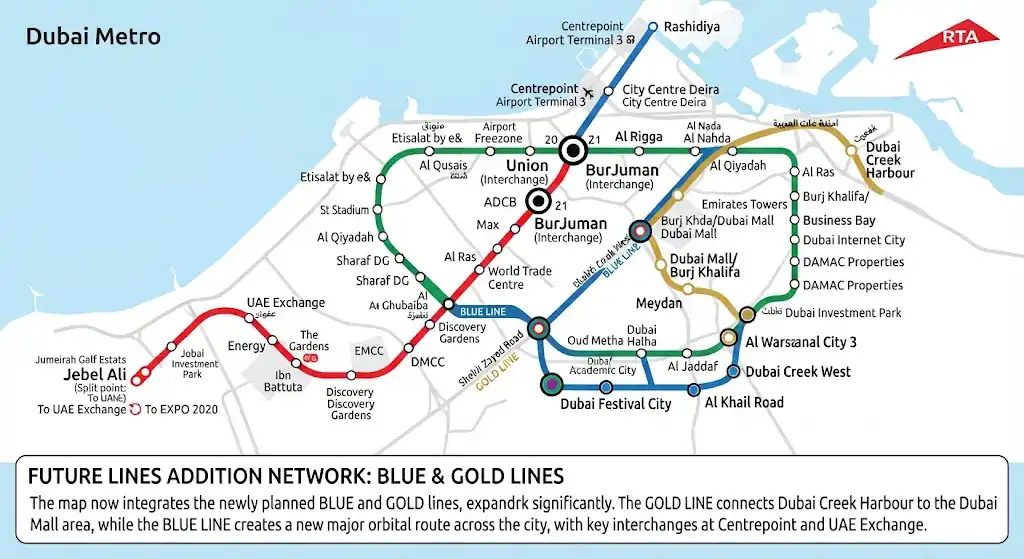
The metro you know is about to change. Two new lines are coming, and they’ll redraw the map for daily riders.
The Blue Line opens September 9, 2029: 30 km, 14 stations, built to connect east Dubai and serve one million residents. The Gold Line is a separate 42 km, 18-station corridor approved in April 2026 with around AED34 billion behind it.
“So it’ll actually reach the east side?” a colleague asked me, staring at the route render. That was the moment the 14-station count clicked: this isn’t a branch extension, it’s a real connector for a million people who currently have no rail option at all. Every time I’ve watched a line get built to an underserved pocket, the pattern repeats: the first six months are quiet, then ridership compounds fast.
The Blue Line is projected to cut road congestion by 20%. For you as a rider, that means fewer cars on parallel routes, so the buses and roads you depend on when the metro doesn’t reach actually move.
What’s still unknown: exact station names, fare zones, and interchange points for both lines. The Blue and Gold line plans track the details as they’re confirmed.
Before you ride, here’s the accumulated wisdom that separates locals from tourists.
Riding Like a Local: Tips, Tricks, and Traps
The Blue and Gold lines are tomorrow’s story. Today you’re standing on a platform, and the habits that separate a daily rider from a stranded tourist come down to three checks.
Check the destination display before you board. Two trains on the same platform can head to different places, and a wrong train costs you a backtrack. This matters most west of Jabal Ali, where the branch split sends some trains one way and some another. Read the electronic sign above the cab, not just the line color.
Know your exit before you arrive. Dubai’s stations are long, and exits can sit hundreds of meters apart.
I walked out of Burjuman through Exit 2 heading for a shop on Khalid Bin Al Waleed Street, only to realize the entrance I needed was at Exit 4 on the opposite end. That cost me a ten-minute detour through afternoon heat I could have skipped by checking the station map before the doors opened. Now I glance at the exit diagram posted inside the carriage every time.
Once you hit the daily cap, extra rides are free. Don’t ration trips. If you’re on your fifth journey and the cap is close, just tap in. The system stops charging you. Tourists who try to “save” rides end up walking in the summer heat to avoid a tap that costs nothing.
Those are the tricks. Now the questions everyone asks.
Conclusion
You’ve seen the whole system. A week ago, the metro probably looked like a fare trap and a timing puzzle. Now you know the zone fare, tap in/tap out, the last train, and your exit strategy. The missed train was the tell. I watched a neighbor freeze at the Jabal Ali branch split, staring at the map as the doors closed, and I knew exactly which mistake he’d made.
One step left: ride it. Buy a Nol card, load the S’hail app, and take the Red Line once end to end. That single trip will teach you more than any guide, and you’ll start seeing the city the way daily riders do.