

Introduction
You tap your Gold nol card at the gate, pay double the fare, and step into the Gold cabin. Only to find yourself standing shoulder to shoulder with a crowd. That’s the reality for peak-hour riders in 2026. The Gold card isn’t a guaranteed premium seat; it’s a bet on timing.
Key Takeaways
- Gold fares are exactly double Silver fares. The real cost is in how often you tap, not the card price.
- Gold cabins can be standing-room-only during peak hours (7-9 a.m., 5-7 p.m.); off-peak, they’re a serene escape.
- Tourists taking 3-4 trips a day will pay an extra around AED 40-75 for a short stay. Usually worth the comfort.
- Daily commuters crossing 2 zones pay an extra AED 220/month; shifting your commute by 30 minutes can make it worthwhile.
- Start with Silver if unsure; you can always buy a Gold card later. No conversion, but you can keep both.
Last Tuesday, I stood pressed against the Gold cabin door at 8 a.m., then stretched across a row of empty seats at 2 p.m. That’s when I stopped treating the Gold card as a blanket upgrade. Many commuters pay double without realizing they’ll still stand during rush hour. This article cuts through the marketing fluff and uses real 2026 crowding data to give you a personalized verdict: is the upgrade worth it for your commute? Most guides skip the only question that matters. Before weighing the costs, let’s clarify exactly what the Gold nol card is and what it actually gets you.
What Is the Gold Nol Card?
Before weighing the costs, let’s clarify exactly what the Gold Nol card is and what it actually gets you.
The Basics of Nol Cards
Nol cards are contactless smart cards that cover all RTA transport: metro, tram, buses, water buses, and paid parking. The system offers four card types, each tailored to a different rider profile.
The Gold card (AED 25, with AED 19 preloaded credit) grants access to the premium Gold cabins. The Silver card is the standard anonymous card for daily commuters. The Blue card is a personalized version that can hold a monthly pass and protect your balance if lost. The Red card is a disposable paper ticket for occasional trips.
Expert Tip: The Gold card costs AED 25 (AED 19 credit), the same as a Silver card, but every trip fare is double the Silver rate.
Gold Class Cabins: What You Get
Gold cabins are the premium sections at the back of every Red Line train and at the front of every Green Line train. On the Tram, it’s a designated zone. Inside, you get wider seats, more legroom, and a noticeably quieter atmosphere. Enforcement is strict. Inspectors regularly check for Gold cards, and fines for riding without one are steep.
The Gold cabin is less a luxury lounge and more a quiet corner at the far end of the platform. We learned this sprinting to the back of a Red Line train on a July afternoon, only to find the Gold section already half-full.
That’s the part nobody warns you about. But here’s the critical limitation: Gold cabins exist only on the Metro and Tram. Buses, water buses, and abras have no Gold section. If your commute involves a bus leg, you’ll be in the same seat as everyone else.
Gold vs Silver Nol Card: Detailed Comparison
Now that you know what the card unlocks, let’s see how it stacks up against the standard Silver card side by side. The table below lays out the key differences at a glance.
| Feature | Gold Nol Card | Silver Nol Card |
|---|---|---|
| Purchase Price | AED 25 (AED 19 credit + AED 6 fee) | AED 25 (AED 19 credit + AED 6 fee) |
| Fare per Zone (Metro/Tram) | AED 6 / 10 / 15 (1/2/3+ zones) | AED 3 / 5 / 7.50 (1/2/3+ zones) |
| Gold Cabin Access | Yes, on Metro and Tram only | No |
| Validity | 5 years from last use, reset by any tap | 5 years from last use, reset by any tap |
| Best For | Off-peak comfort, tourists, guaranteed seat | Daily commuters, budget travelers, bus-heavy routes |
| Where to Use | All RTA transport; Gold cabin only on Metro/Tram | All RTA transport |
| Personalization | Optional registration for balance protection | Optional registration for balance protection |
Does the Gold card make sense on the bus? A friend visiting from London grabbed a Gold card on my advice, then messaged me from the 8 bus to JLT: “I paid double and I’m standing in the aisle.” That’s the part the brochure doesn’t mention: Gold fares apply on every mode, but the wider seat only exists on the metro and tram. On a bus, you’re paying a premium for the same plastic seat as everyone else.
Now that the basics are clear, let’s unpack the fare structure and what those double fares actually mean for your wallet.
Fare Structure and Cost Analysis
With the basics clear, let’s dig into the fare structure and what those double fares actually mean for your wallet.
How Zone-Based Fares Work
Dubai’s 7-zone system charges by zones crossed, not distance. Gold fares are exactly double Silver: 1 zone 6/3, 2 zones 10/5, 3+ zones 15/7.50. A daily cap (Gold 20, Silver 14) makes further trips free.
Real-World Journey Cost Examples
Marina–JLT (1 zone): 6/3. Burj Khalifa–Mall of the Emirates (2 zones): 10/5. Deira–Marina (4 zones): 15/7.50. Rashidiya–UAE Exchange (7 zones): 15/7.50.
Monthly Cost Projections for Commuters
A daily 2-zone round trip adds 10/day (300/month); a 3-zone round trip adds 6/day (180/month) because both cards hit their caps.
AED 20, the Gold daily cap I circled, but my 2-zone commute never triggers it.
Expert Tip: If your monthly Gold premium exceeds AED 100, ask whether the comfort is worth it. The answer often hinges on your ability to travel off-peak.
Knowing the costs is one thing. Next, here’s exactly how to get a Gold card in your hand and keep it topped up.
How to Buy and Top Up Your Gold Nol Card
Knowing the costs is one thing. Here’s how to get a Gold card and keep it topped up.
Purchasing a Gold Nol Card
You can buy a Gold Nol card through the RTA website, the nol Pay app, ticket offices, station vending machines, or authorized retailers like Zoom and Carrefour. The card costs AED 25, which includes AED 19 of preloaded credit and a non-refundable AED 6 fee. Silver cards cannot be converted.
Vending machines are the official quick option. I queued 15 minutes at a busy interchange station only to find the machine didn’t accept cash, a frustrating start to a AED 25 purchase. Now I use the nol Pay app exclusively.
Product Recommendation: Keep both a Silver and Gold Nol card. You cannot convert an existing Silver card, so buy a separate Gold card for premium cabin access.
Topping Up Your Balance
You can top up your Nol card online via the nol Pay app, the RTA website, station vending machines, or retail outlets. The app and website let you skip station queues entirely.
Expert Tip: Top up through the nol Pay app to avoid queues, and set a low-balance alert to prevent gate delays.
Where You Can Use the Gold Nol Card
You’ve got the card and the credit: now where can you actually use it, and where does the premium benefit stop?
Transport Modes
Gold cabin access is exclusive to Dubai Metro and Tram. Buses, water buses, and abras have no premium section. On a bus to Al Quoz last January, I tapped my Gold nol and found no separate cabin. Paid parking works, but that’s a standard nol feature, not a Gold perk.
Limitations to Keep in Mind
Gold cabin is only on Metro and Tram. No intercity buses, other emirates, or non-RTA services. It’s a standard e-purse card with added cabin access, not a universal premium pass.
Now the big question: with all these limitations in mind, is the Gold nol card actually worth the extra money for you?
Is the Gold Nol Card Worth It? A Cost-Benefit Analysis
Now the big question: with all this in mind, is the Gold Nol card actually worth the extra money for you?
For the Daily Commuter
At 8 a.m. from Burjuman, we squeezed into the Gold cabin and found it standing-room only, exactly what that Reddit user described.
A 2-zone round trip costs AED 20 on Gold versus AED 10 on Silver. That’s AED 50 extra per week, or roughly AED 220 a month.
During peak hours, the Gold cabin is often standing-room only. You pay double for the same crush. Only flexible off-peak commuters see the benefit.
For the Occasional Traveler
Two or three off-peak trips a week cost a few dirhams more per ride. The Gold cabin is half-empty, and you’ll almost always get a wide seat. The small premium buys reliable comfort without the monthly commitment.
For Tourists (3-7 Day Visit)
A 5-day, 15-trip itinerary across 2 zones adds about AED 75 to your transport budget. After hours of walking in the heat, a quiet, air-conditioned seat feels like a bargain. The extra cost is less than a single taxi ride, and you’ll arrive at your next stop refreshed.
Expert Tip: For tourists using the metro frequently over 3-5 days, the Gold card’s comfort after long sightseeing days easily justifies the small extra cost.
Decision Flowchart (Visual Suggestion)
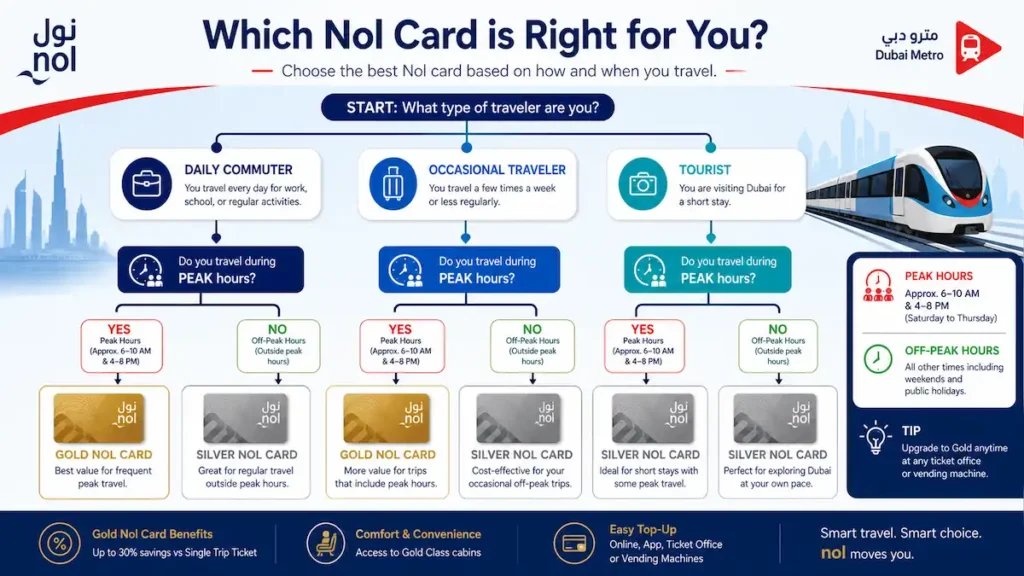
Gold Nol Card for Tourists vs Residents
The value equation shifts depending on whether you’re a resident or a tourist. Let’s break down the differences.
Tourists: What You Need to Know
You can buy a Gold Nol card right at the airport metro station with no registration, no ID, and no paperwork. The card costs AED 25, which includes AED 19 of preloaded credit and a non-refundable AED 6 card fee. That fee is the price of instant access, and for a short trip it is a fair trade.
A three-day itinerary using Gold will run you about AED 40–50 more than a standard Silver card. But the upgrade buys you a seat and a noticeably calmer ride between Dubai’s top attractions. You step off the plane, tap in, and head straight to the front or rear of the train. The wider seats and quieter cabin make the journey feel less like transit and more like a proper start to your holiday.
Leftover balance at the end of your trip is not lost. You can spend it at Zoom supermarkets, some petrol stations, or even on a taxi ride, so topping up a little extra on day one often works out. The card itself stays valid for five years from your last tap, so if you return to Dubai you can pick up right where you left off.
Residents: Long-Term Value
For residents, the Gold card is a daily decision, not a one-off purchase. The math is simple: if you value a guaranteed seat at AED 10 per day, Gold pays for itself with 22 off-peak days a month. That is the break-even point. The comfort premium stops feeling like a splurge and starts looking like a sensible routine.
Registering your card is the single smartest thing you can do as a resident. I learned that the hard way when I lost a Gold Nol with AED 50 still on it. Without registration, the balance vanished. No way to recover it. Now I register every card the day I buy it, and I’ve never lost a dirham since. Registration links the card to your Emirates ID or mobile number, so if it goes missing you can block it and transfer the balance to a replacement. It takes two minutes on the RTA app and costs nothing.
You can also get a personalized Gold Nol card with your name and photo, which adds a layer of security and makes it feel like your own. The card fee is the same AED 6, and the preloaded credit is identical. The real value is the peace of mind.
Tips for a Premium Gold Class Experience
If you do go Gold, a few insider tips can make the experience dramatically better. Here’s how to actually enjoy that premium cabin.
Why does your Gold cabin ride sometimes feel like a Silver sardini can? I asked myself that after my third standing-room-only commute in a week. The answer, I’ve learned over seven years of riding the metro, is simple: timing is everything. Off-peak, the Gold cabin is half-empty and you’ll always get a seat; during peak, you’re paying double to stand shoulder-to-shoulder.
Best Times To Travel
The single biggest factor is when you ride. Off-peak windows, 10 a.m. to 4 p.m. and after 7 p.m. on weekdays, plus all day weekends, are when Gold cabins are genuinely half-empty and seats are nearly guaranteed. Reddit users in 2025-2026 consistently report that the same cabin that’s standing-room only at 8 a.m. feels like a private lounge at 11 a.m.
Cabin Etiquette and Practical Advice
Board at the gold-marked doors on the platform; they line up directly with the Gold cabin. Keep phone calls quiet and use the overhead luggage space so the wider seats stay clear. Enforcement against Silver card holders is inconsistent, so don’t count on it.
Expert Tip: Report Silver card holders to RTA if you wish, but inconsistent enforcement means your best bet for a seat is traveling off-peak when the cabin is half-empty.
Maximizing Comfort
Choose the first or last Gold car. They’re often the quietest. Use the RTA app to time your train and avoid a packed platform. The wider seats are a real perk if you’re traveling with a companion.
Still have questions? The FAQs ahead cover the most common ones, from expiry to kids in Gold class.
Real User Reviews & Social Media Sentiment (2025-2026)
Beyond the official specs, what are real riders actually saying? Here’s the unfiltered word from Reddit and social media.
Reddit threads from 2025 and 2026 call peak-hour Gold cabins a ‘sardine can’: standing-room only and not worth double. I expected a premium cabin to feel premium regardless of the clock. At 8 a.m. on a Tuesday, I stood shoulder-to-shoulder in a Gold cabin that felt no different from Silver. At 11 a.m. on a Thursday, it was half-empty and serene. The tell: if the platform is packed, Gold won’t save you.
Off-peak and weekend users, however, describe a quiet oasis with guaranteed seating and a noticeably calmer atmosphere.
Final Verdict: Should You Buy a Gold Nol Card?
So, after all the numbers, the real experiences, and the practical tips: what’s the final call?
The 7:42 a.m. train pulls in, and we already know the Gold cabin will be standing-room only. We clock dozens of trips a month; the wider seats are the only reason we don’t arrive already exhausted.
Buy Gold if you travel off-peak or value a guaranteed seat. Stick with Silver if you commute during peak hours. Start with Silver and upgrade later if you need the space, but you can also save up to 50% on fares with the right pass.
Ultimately, it’s a comfort bet, not a luxury pass: the clock decides if you win.