
Introduction
I was standing on the Burjuman platform, scrolling through my nol Pay app, when I saw I’d burned through AED 550 in a single month, all on 3‑zone trips at AED 7.50 a tap. That’s the moment I did the maths: an all‑zone pass at AED 350 would have put AED 200 back in my pocket.
Key Takeaways
- A monthly pass breaks even at 23–24 return trips for Silver users; fewer if you travel on weekends.
- Students and seniors with a Blue card save 50% immediately: the pass pays for itself from day one.
- The all‑zone pass is only worth it if you regularly cross 3+ zones; otherwise, a 2‑zone pass plus occasional single trips is cheaper.
- Always keep AED 7.50 on your card; the metro gates won’t open without it, even with a valid pass.
- Use the S’hail app to check your zones before buying; guessing costs you money.
Most Dubai commuters overpay by AED 100 or more every month, not because they ride too much, but because the zone system and pass rules are genuinely confusing. You stand at the gate doing mental zone maths, worried you’ll pick the wrong pass and waste even more. It’s a daily frustration that doesn’t need to exist.
This guide replaces the guesswork with a personalised break‑even formula, exact 2026 prices, and real‑life case studies that show you, down to the dirham, when a monthly pass puts money back in your pocket. We’ll start with the problem (overpaying), agitate the confusion, then walk you through the solution step by step.
Now let’s start with the basics: what a nol monthly pass is and what it covers.
What Is a Nol Monthly Pass?
Before we compare prices, let’s get clear on what you’re actually buying.
A nol monthly pass is a 30‑day unlimited‑travel product loaded onto your nol card, not a calendar‑month subscription. It covers unlimited trips on the Dubai Metro, tram, and RTA buses within the zone range you choose. Inter‑city buses and some marine services are excluded.
The RTA’s ‘monthly’ pass is a misnomer that will catch you out if you’re not paying attention. We assumed it was a calendar month and got caught mid‑commute when the pass expired on day 30, not the 31st. It’s 30 days from first use, not the 1st to the 31st.
You pick a zone range, 1 zone, 2 zones, or all zones, and the pass is valid only for travel within those zones. The pass can be loaded onto Silver, Gold, or Blue nol cards, but the card tier must match the pass type (a Gold pass requires a Gold card).
Expert Tip: If your weekly routine crosses more than 2 zones even once, the all‑zone pass often pays for itself. Don’t just look at your daily office commute.
The pass you can buy depends on the card in your wallet. Here’s how each card type works.
Nol Card Types and Eligibility for Monthly Passes
Your card determines which pass you can buy and what you’ll pay. Wondering if your current card can hold a monthly pass? I tried loading one onto a Red ticket. The machine refused. I switched to Silver that day.
Silver Nol Card
The Silver nol card is a standard anonymous adult card. Costs a small fee, no discounts, no balance recovery if lost. Baseline for monthly passes.
Gold Nol Card
The Gold nol card is a premium card for Gold Class cabins. Monthly pass costs roughly double Silver. Expert Tip: For occasional Gold use, stick with a Silver pass and pay the upgrade fare (around AED 5–10) per trip.
Blue Nol Card
The Blue nol card is a personalised card for student and senior discounts. After RTA verification, you get 50% off monthly passes. Balance protection and online management included. Product Recommendation: Students and seniors: apply for a Blue card to unlock 50% monthly pass discounts and save significantly over the year.
Red Nol Card
Paper ticket for occasional travellers. No monthly pass support. Switch to Silver, Gold, or Blue.
Now that you know your card, let’s tackle the biggest source of confusion: Dubai’s zone map.
Dubai Public Transport Zone System Explained
Zones are where most people bleed money without realising it. Let’s fix that.
How Zones Work
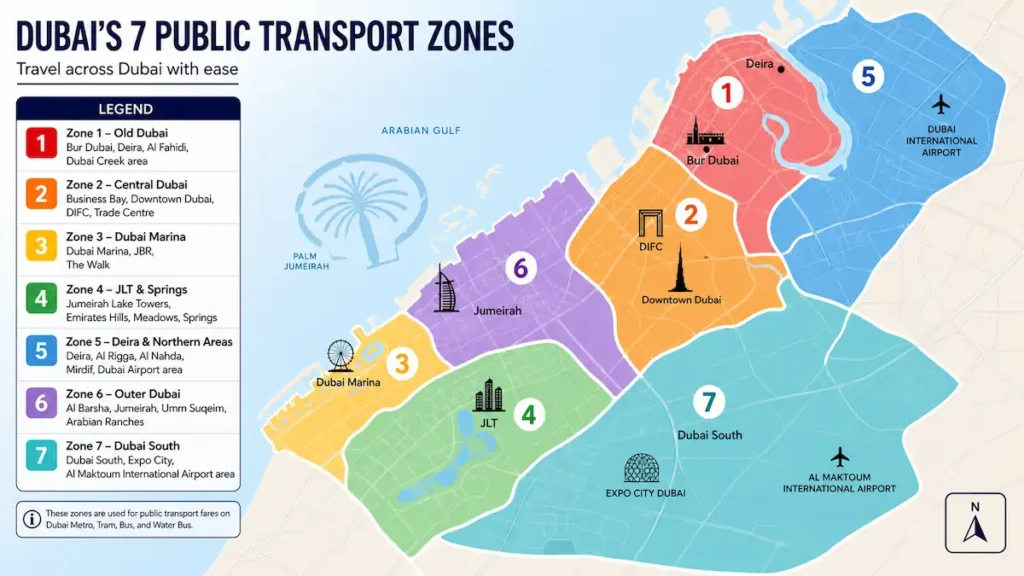
Dubai is carved into 7 zones. Your fare depends on how many you cross, 1, 2, or 3+. The all‑zone pass covers all 7.
Here’s the catch: zone boundaries aren’t drawn by distance. A short hop from Deira to Bur Dubai can cross two zones, while a longer ride along Sheikh Zayed Road might stay in one. That’s why guessing is expensive.
How to Determine Your Daily Zones
The S’hail app is the only official tool that shows your exact zone count for any journey, Google Maps won’t tell you. Open the app, enter your home and work stops, and note the “Zones” number. Do the same for your weekend haunts. Your daily zone count is the foundation for choosing a pass. Miscount by one zone and you could overpay by hundreds of dirhams a year.
Three zones, that’s what S’hail showed for my daily commute from Deira to DIFC, not the two I’d assumed for years, and it instantly flipped my pass math. That’s why nailing your daily zone count is the first step.
Expert Tip: Always check your weekend travel zones. A 1‑zone weekday commute might become a 2‑zone trip on Fridays if you head to Dubai Marina, changing your pass needs.
With your zone count in hand, here are the exact 2026 pass prices.
Monthly Pass Prices Table (2026)
Here are the numbers that matter for a monthly pass: every price, every card type, in one place. I assumed the Gold pass was a tourist trap until I did the maths. Double the Silver rate sounds steep, but on a 2-zone commute, that’s AED 460 a month for a guaranteed seat in a quiet cabin. On days when the metro is packed, that premium feels like a bargain.
The table below lays out the full 2026 pricing. All passes are valid for 30 days of unlimited travel within the selected zone coverage.
| Card Category | 1 Zone (AED) | 2 Zones (AED) | All Zones (AED) |
|---|---|---|---|
| Silver (Adult) | 140 | 230 | 350 |
| Gold (Adult) | 280 | 460 | 700 |
| Blue – Student (50% off) | 70 | 115 | 175 |
| Blue – Senior Citizen (50% off) | 70 | 115 | 175 |
| Blue – Adult (no discount) | 140 | 230 | 350 |
Now let’s walk through exactly how to buy or renew your pass.
How to Purchase and Renew a Monthly Pass
You’ve picked your pass: here’s how to get it onto your card in under five minutes. All three channels work, but the app is the one I reach for first.
Option 1: Via the RTA Website
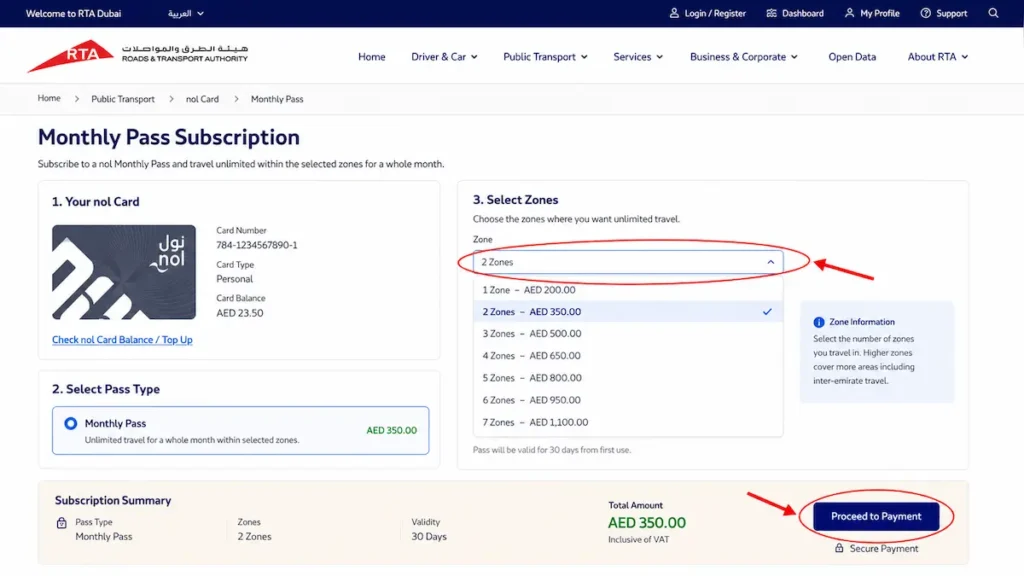
Log into your RTA account, select your nol card, and choose “Monthly Pass.” Pick your zone coverage from the dropdown, confirm the price, and pay with a debit or credit card. The pass activates immediately and shows in your account.
Option 2: Via the nol Pay App
Open the nol Pay app, tap your card, and hit “Buy Pass.” Select the monthly option, choose your zones, and pay. The app stores your travel history and lets you top up your nol card in seconds.
Product Recommendation: The nol Pay app is the most convenient way to manage your pass, showing balance, travel history, and allowing on‑the‑go top‑ups.
Option 3: At a Metro Station Ticket Office
Walk up to any metro ticket window, hand over your nol card, and tell the agent which monthly pass you want. You can pay cash, and the agent loads the pass while you wait. It’s the best route if you prefer face‑to‑face service or don’t have a card linked online.
Expert Tip: Renew online or via the app at least one day before expiry, or set up auto‑renewal to avoid any gap in coverage.
Auto‑Renewal and Minimum Balance
Set up auto‑renewal during purchase, on the website or app, and the pass will reload itself 30 days later. No lapses, no last‑minute panic.
Last August, rushing to a meeting in Business Bay, I tapped my card at the gate and got a red error. I had a valid monthly pass, but the screen flashed “Insufficient balance.” That’s when the AED 7.50 minimum balance rule clicked: the gate doesn’t care about your pass if your stored value is below that threshold. I topped up on the spot, but the lesson stuck. The AED 7.50 minimum balance rule is non‑negotiable: your card will be rejected at the gate even with a valid pass if the balance is too low.
Expert Tip: To avoid a coverage gap, renew at least a day before expiry or enable auto‑renewal.
The real question: does the pass actually save you money? Let’s run the numbers.
Savings Analysis: Monthly Pass vs. Pay‑As‑You‑Go
This is the section that answers the big question: “Is it actually worth it?” The short answer: it depends on how many trips you really take, and most of us underestimate that number.
How to Calculate Your Break‑Even Point
The break‑even point is the number of single trips where the pass price equals what you’d pay per trip. The formula is simple: Pass Price ÷ Single Trip Fare = Break‑Even Trips. For a Silver card crossing 2 zones, that’s AED 230 ÷ AED 5 = 46 trips.
If you commute 22 days a month, that’s 44 trips, two short of break‑even. We were staring at the nol Pay app, adding up a month of trips, when we realised the pass only wins if you count the Saturday trips to the beach.
That extra AED 5 each way flips the 2‑zone Silver pass from a loss to an AED 30 saving.
So the real question isn’t just your office commute; it’s every trip you take in a month.
Break‑Even Table for Common Scenarios
The table below shows how the numbers play out for typical commuters. Notice that a strict 22‑day work commute rarely breaks even on its own, but add a few weekend trips, and the pass starts paying you back.
| Commute Type | Daily Trips (Return) | Days/Month | Pay‑As‑You‑Go (AED) | Pass Price (AED) | Monthly Saving (AED) |
|---|---|---|---|---|---|
| 1 zone Silver 22 days | 1 | 22 | 132 | 140 | -8 |
| 2 zones Silver 22 days | 1 | 22 | 220 | 230 | -10 |
| 3+ zones Silver 22 days | 1 | 22 | 330 | 350 | -20 |
| 2 zones Silver 26 days (incl. weekends) | 1 | 26 | 260 | 230 | 30 |
| 3+ zones Gold 22 days | 1 | 22 | 660 | 700 | -40 |
| 2 zones Student Blue 22 days | 1 | 22 | 115 |
Gold pass users rarely break even on a standard commute. The AED 700 pass for all zones needs 47 trips, and 44 trips leaves you AED 40 short. Unless you ride Gold Class every single trip, a Silver pass with the occasional Gold upgrade is the smarter play.
Students and seniors get 50% off passes, which cuts the pass price in half. If you also qualify for discounted single fares, the break‑even number of trips stays the same. The real win is that the pass costs less, so you’re not risking much if your travel dips.
Expert Tip: If you take more than 2 return trips per day (e.g., school run + office commute), a monthly pass almost always saves money, often AED 50–100+ per month.
Numbers are one thing. Let’s see how they play out for three real Dubai commuters.
Real Commuter Case Studies
Case Study 1: The Office Worker (Bur Dubai to DIFC): Ahmed’s 2‑zone Silver commute: show pay‑as‑you‑go vs. pass, including weekend trips, and a AED 30 monthly saving.
Ahmed taps in at Bur Dubai and out at DIFC, five days a week. That’s 44 trips a month. Add four weekend outings (a Friday brunch in Marina, a Saturday stroll at City Walk) and he’s at 52 trips.
Pay‑as‑you‑go: 52 × AED 5 = AED 260. The 2‑zone Silver monthly pass costs AED 230. He pockets AED 30.
The 2-zone pass is the sleeper hit of the nol system. I watch colleagues in Bur Dubai burn through AED 260 a month on pay-as-you-go while I tap the same gates for AED 230. That extra AED 30 is a Friday shawarma and karak, no exaggeration. The pass pays for itself the moment you add a weekend trip to your routine.
Case Study 2: The University Student (Academic City to Internet City): Sara’s 3+‑zone Blue student commute: demonstrate the massive AED 230 monthly saving with the 50% discount.
Sara’s daily trek from Academic City to Internet City crosses three zones. She makes 44 trips for classes and another 10 for study groups and socials: 54 trips total.
Pay‑as‑you‑go at AED 7.50 a trip would cost AED 405. With a student nol card, her student pass is half the Silver rate: AED 175. She saves AED 230 every month.
Case Study 3: The Family with School Run (Mirdif to Jumeirah): Fatima’s multi‑trip 2‑zone Silver commute: show how 4 trips/day make the pass a AED 210 monthly saver.
Fatima does the school run from Mirdif to Jumeirah. That means drop‑off, return home, pick‑up, return home: four trips a day, 22 school days. That’s 88 trips. Pay‑as‑you‑go at AED 5 a trip would total AED 440. The 2‑zone Silver pass at AED 230 saves her AED 210.
Want to run your own numbers? The calculator below does the maths for you.
Interactive Savings Calculator
Plug in your own commute, the calculator tells you instantly whether a pass is worth it.
Will a monthly pass actually save me money? I asked myself that when I started commuting from JLT to DIFC every day. The RTA’s zone map told me how many zones I crossed, but not what it would cost. So I built this tool to do the maths for you, using the exact 2026 fares and pass prices I’ve been tracking since the last fare update.
How the Calculator Works
You pick your nol card type (Silver, Gold, or Blue), the number of zones you travel, your typical trips per day, and how many days a month you ride. The calculator instantly shows your pay‑as‑you‑go cost, the recommended pass, your exact dirham saving, and the break‑even point.
It runs entirely in your browser using JavaScript. No data leaves your device. The tool is for guidance; always confirm final prices on the RTA website.
Still have questions? The FAQ covers the edge cases.
Final Tips to Maximise Your Nol Monthly Pass
You’ve got the pass. Here’s how to make sure you never leave money on the table.
I expected the pass to be a magic key, but the gate beeped me back: AED 5 balance, pass valid. That AED 7.50 minimum is the silent killer. Keep at least AED 7.50 on your card. Double-check your zone count in the S’hail app. Switch to a Blue nol card for student/senior discounts and balance protection, set a calendar reminder three days before expiry, and ask your employer about corporate pass discounts.
Product Recommendation: For the smoothest experience, pair a Blue nol card with the nol Pay app: you’ll get balance protection, discount eligibility, and one‑tap renewal.