
Introduction
You’re standing in front of a ticket machine, the screen flashing zone maps and fare options you’ve never seen before. Sweat still drying from the 40-degree walk, I stood at Burjuman’s ticket machine watching zone options I didn’t understand. That was the moment I ditched single tickets for a Silver nol card and never looked back.
Most metro guides hand you a map and a fare table and call it done. They skip the real-world shortcuts commuters rely on: which exit avoids a 15-minute walk in the heat, when Gold Class costs less than a coffee, and how the Silver card’s daily cap turns unlimited exploration into a bargain.
This guide is different. It’s written by a daily rider who’ll show you exit strategies, fare hacks, and timing tips so you navigate the Dubai Metro with the confidence of a local, not a lost tourist.
Key Takeaways
- A Silver nol card caps your daily travel at AED 20, cheaper than a single taxi ride
- Knowing the right station exit (like the air-conditioned walkway at Burj Khalifa/Dubai Mall) saves you a 15-minute walk in the heat
- Avoid peak hours (7:30–9:00 AM and 5:00–7:00 PM weekdays) for a calm, comfortable journey
- Free park-and-ride at Centrepoint, Etisalat, and Jebel Ali makes driving in from the outskirts practical and affordable
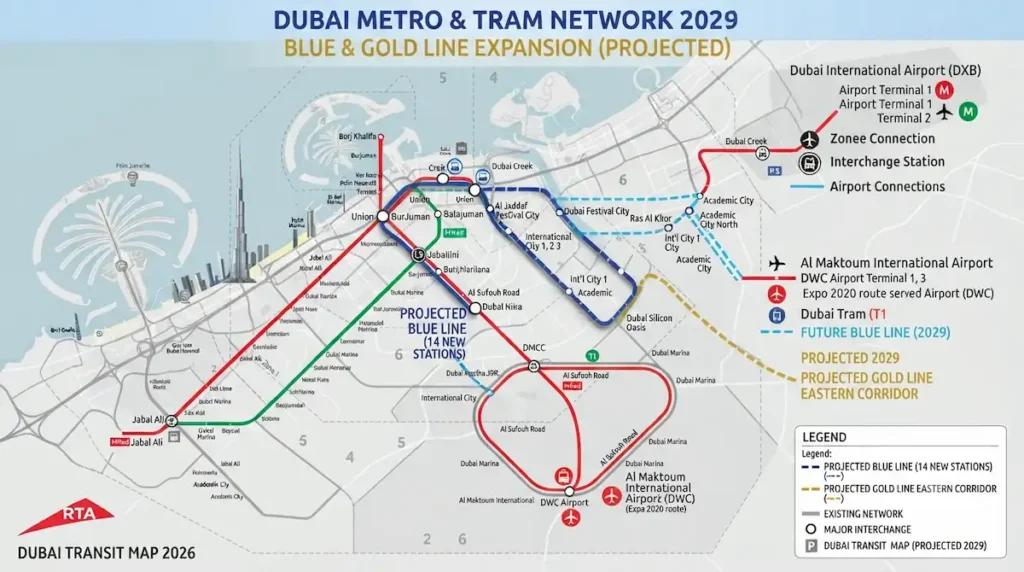
- The Blue Line (opening 2029) will link both airports by metro, reshaping airport transfers
Before looking at stations and fares, let’s get the lay of the land: here’s how the whole network fits together.
Dubai Metro Network Overview
Before looking at stations and fares, here’s how the whole network fits together.
Red Line: The City’s Backbone
The Red Line runs roughly 52 km from Centrepoint (near Dubai International) to Expo 2020. Its 35 stations link the airport, Deira, Burj Khalifa/Dubai Mall, and Dubai Marina. Trains run Monday to Thursday and Saturday from 5:00 AM to midnight, Friday until 1:00 AM, and Sunday from 8:00 AM to midnight. These hours are confirmed against official RTA timetables and daily use.
Expert Tip: The metro station is inside Terminals 1 and 3. Follow the signs. It’s often faster and cheaper than a taxi to the city center.
Peak hours (7–9 AM and 5–8 PM) turn the Red Line into a sardine can, especially around BurJuman and Union, the network’s two busiest interchange stations.
The network’s biggest headache is those interchanges. BurJuman and Union are the busiest stations in the system, and the promise of a quick transfer dissolves during the morning crush.
We’ve learned to avoid changing trains there between 7 and 9 AM, even if it means riding an extra stop or two to a quieter station.
Green Line: The Historic & Commercial Spine
The Green Line stretches roughly 22.5 km from Etisalat to Creek, with 20 stations threading through old Dubai: Al Fahidi, the Gold Souk, and the Creek. It shares the same operating hours as the Red Line and crosses it at BurJuman and Union, so you can switch lines at either hub. Outside peak times, it’s a calm ride through the city’s heritage quarter.
Now that you know the lines, let’s look at the map that ties it all together. Download a copy for your phone.
Dubai Metro Map
Now that you know the lines, let’s look at the map that ties it all together. Then download a copy for your phone.
The map shows all 55 stations, zone boundaries, and highlights interchange stations (Union, BurJuman) and airport connections. A dashed line marks the future Blue Line, part of the 2032 expansion to 81 stations.
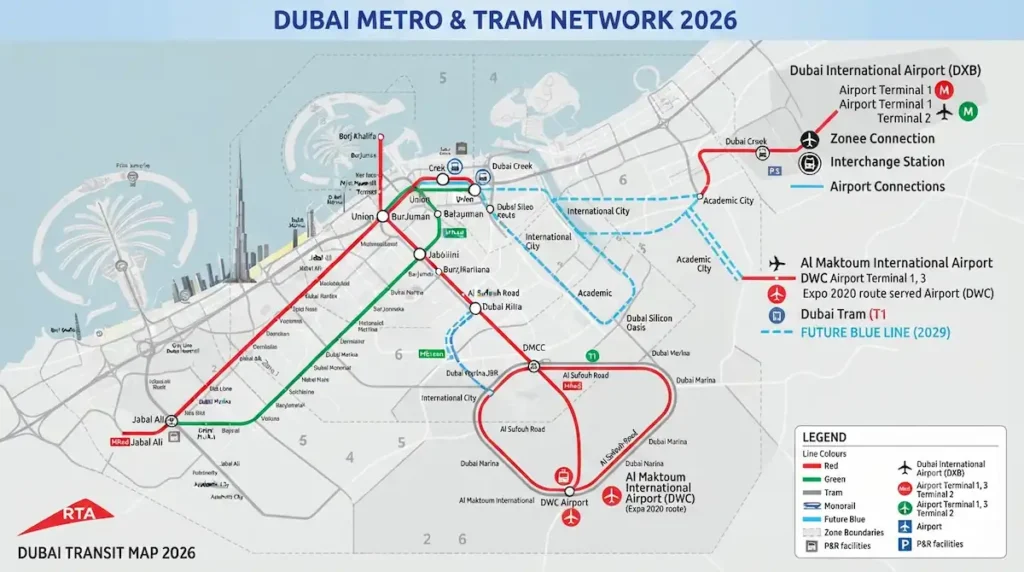
Ever tried to figure out which exit to take from a station while your phone data is running out? I downloaded the map to my phone before my first week of commuting, and it saved me from a 15-minute walk in the sun more than once. Download it so you can zoom in on station exits without needing mobile data.
With the map sorted, the next question is: how do I pay? Let’s break down the nol card.
Nol Card Guide: Types, Purchase & Top-Up
With the map in hand, the next question is always: how do I pay? Let’s break down the nol card.
Which Nol Card Should You Get?
The Silver card costs AED 25 and comes with AED 19 of travel credit. Its real power is the daily cap: once you’ve spent AED 20 in a day, every extra trip is free. AED 20. That’s what I paid for a full day of metro hopping, less than a single taxi ride from the airport. For most visitors and residents, it’s the only card you’ll need.
Gold Class costs the same AED 25 upfront, but each ride deducts roughly double the Silver fare. The trade-off is a quieter, more spacious cabin at the very front of the train, a genuine sanity-saver during the 7:30–9:00 a.m. crush. If you’re commuting daily, the upgrade can pay for itself in comfort.
The Red Ticket is a paper card for one-off trips. You pay AED 2 for the card itself plus the fare, and there’s no daily cap. It works if you’re taking exactly one ride and never touching the metro again, but even a short stay quickly makes a Silver card cheaper.
The Personal card requires registration and offers auto top-up, so your balance never runs dry. The convenience is real, but the extra step only makes sense if you’re a long-term resident who rides daily and hates topping up. For everyone else, the Silver card’s simplicity wins.
Expert Tip: Even for a short stay, a Silver card’s AED 20 daily cap makes it cheaper than multiple Red Tickets.
How to Buy and Top Up
You can grab a nol card at any metro station ticket machine, the nol Pay app, the RTA website, or authorized retailers like Zoom and Carrefour. At a station machine, tap “Buy New Card,” pick Silver or Gold, insert cash or card, and the machine spits out your nol card ready to use.
Topping up is just as straightforward. Station machines accept cash and card; the nol Pay app lets you top up, check your balance, and view travel history instantly, no machine queues. You can also top up at RTA customer service counters or partner shops. If you’re topping up for a group, the app is the fastest way to load credit onto multiple cards without holding up a line.
Product Recommendation: The nol Pay app lets you top up, check your balance, and view travel history instantly, no machine queues.
Card in hand, the next thing you’ll want to know is exactly what each trip will cost you. Here’s the fare system, plain and simple.
Fare Zone System & Fare Table
Card in hand, you’ll want to know exactly what each trip costs. Here’s the fare system, plain and simple.
Dubai’s metro charges by how many of the city’s 7 fare zones you cross, not by distance. A one-zone hop costs the same whether you ride one stop or five, as long as you stay inside that zone. Cross into a second zone and the fare ticks up. Reach three or more zones and you hit the maximum single-trip charge; after that, the price stays flat no matter how far you go.
The Silver nol card’s real magic is the daily cap.
Spend AED 20 in a day and every tap after that is free. I budgeted AED 50 for a day of hopping between meetings in Deira and Dubai Marina, but my Silver card stopped deducting after AED 20.
That’s when I finally understood the daily cap: it’s built into the card and kicks in automatically, no opt-in needed. That cap turns a day of sightseeing into a flat-rate pass, often cheaper than a single taxi ride.
Gold Class fares are roughly double the Silver fare. For the price of a coffee, you get a quieter cabin at the front of the train with more space and almost always a seat.
Red Tickets have no daily cap, so they’re best for one-off trips or very light use.
Before you travel, open the RTA app and check the zone crossing for your route. It’s the fastest way to confirm your exact fare, as the table below shows typical charges.
| From Station | To Station | Zones Crossed | Silver Card Fare (AED) | Gold Card Fare (AED) | Red Ticket Fare (AED) |
|---|---|---|---|---|---|
| Airport Terminal 1 | Burj Khalifa/Dubai Mall | 2–3 zones | 5–7 | 10–14 | 6–8 |
| Burj Khalifa/Dubai Mall | Mall of the Emirates | 2 zones | 5 | 10 | 6 |
| Mall of the Emirates | Sobha Realty (Marina) | 1 zone | 3 | 6 | 4 |
| Union | BurJuman | 1 zone | 3 | 6 | 4 |
| Centrepoint | Jebel Ali | 3+ zones | 7.5 | 15 | 8.5 |
| Etisalat | Creek | 2–3 zones | 5–7.5 | 10–15 | 6–8.5 |
| Dubai Marina | Palm Jumeirah (via tram transfer) | 1 zone | 3 | 6 | 4 |
| Union | Airport Terminal 3 | 1 zone | 3 | 6 | 4 |
| Burj Khalifa/Dubai Mall | Dubai Marina | 2 zones | 5 | 10 | 6 |
Expert Tip: The Silver card’s AED 20 daily cap applies automatically: just tap in and out as usual and you’ll never pay more than AED 20 in a day.
Station-by-Station Directory
Now let’s put that knowledge to work: which station do you actually need, and which exit gets you where you’re going?
Last August, during a project that had me commuting to Bur Dubai daily, I made the mistake of following the crowd out of BurJuman’s exit 1. Ten minutes later I was still walking in the sun, sweating through my shirt, when the office I needed was right behind exit 3. That’s the kind of wasted time this directory is built to prevent.
BurJuman and Union are the busiest interchange stations, 136.5 million riders passed through the metro in the first half of 2026 alone, and knowing the right exit before you tap out is the difference between a two-minute stroll and a 15-minute detour.
| Station | Line | Nearby Landmarks & Attractions | Transport Connections |
|---|---|---|---|
| Burj Khalifa/Dubai Mall | Red | Dubai Mall, Burj Khalifa, Dubai Fountain | Feeder buses, taxi rank |
| Business Bay | Red | Dubai Water Canal, Bay Square | Feeder buses |
| Mall of the Emirates | Red | Mall of the Emirates, Ski Dubai | Feeder buses |
| Sobha Realty (formerly Dubai Marina) | Red | Dubai Marina Mall, JBR Beach | Dubai Tram, feeder buses |
| Jumeirah Lakes Towers | Red | JLT cluster, DMCC | Dubai Tram, feeder buses |
| Airport Terminal 1 | Red | DXB Terminal 1 | Feeder buses, taxi rank |
| Airport Terminal 3 | Red | DXB Terminal 3 | Feeder buses, taxi rank |
| Centrepoint (Rashidiya) | Red | Rashidiya | Park-and-ride, feeder buses |
| Jebel Ali | Red | Jebel Ali Industrial Area | Park-and-ride, feeder buses |
| BurJuman | Red & Green | BurJuman Mall, Bur Dubai | Feeder buses, interchange |
| Union | Red & Green | Union Square, Al Ghurair Centre | Feeder buses, interchange |
| Al Fahidi | Green | Al Fahidi Historical Neighbourhood, Dubai Museum | Feeder buses |
| Etisalat | Green | Al Qusais | Park-and-ride, feeder buses |
| Creek | Green | Dubai Creek, Deira | Feeder buses |
| Ibn Battuta | Red | Ibn Battuta Mall | Feeder buses |
| DMCC | Red | JLT, Dubai Marina | Dubai Tram, feeder buses |
| Expo 2020 | Red | Expo City Dubai | Feeder buses |
| Dubai Internet City | Red | Dubai Internet City, Media City | Feeder buses |
| Al Rigga | Red | Al Rigga Road, Deira | Feeder buses |
| Deira City Centre | Red | Deira City Centre mall | Feeder buses |
Park-and-Ride Guide
If you’re driving to a station instead, here’s where you can park for free. Four stations offer dedicated park-and-ride facilities with free multi-storey parking when you tap your nol card at the barrier and use the metro. All are open 24/7.
| Station | Parking Type | Capacity | Cost | Restrictions |
|---|---|---|---|---|
| Centrepoint (Rashidiya) | Multi-storey | 2,700+ spaces | Free with nol card | Arrive before 8 AM on weekdays to guarantee a spot |
| Etisalat (e&) | Multi-storey | Large capacity | Free with nol card | 24/7, must tap nol card |
| Jebel Ali | Multi-storey | Ample spaces | Free with nol card | 24/7, must tap nol card |
| National Paints | Multi-storey | Good availability | Free with nol card | 24/7, must tap nol card |
| Other stations | Limited street parking | Varies | Paid or time-limited | Not dedicated park-and-ride; check local signs |
Expert Tip: For Sharjah and northern emirate commuters, Centrepoint is the most convenient park-and-ride. Arrive before 8:00 AM to guarantee a spot.
We pulled into Centrepoint at 7:45 AM. The multi-storey was already half-full. We tapped our nol card at the barrier: free parking, no ticket needed. That early arrival habit is why we never stress about finding a space, even on a Monday morning.
Accessibility & Facilities
The metro is designed to be accessible to everyone. Here’s what to expect if you have mobility needs, a stroller, or a visual impairment.
Every station has elevators from street to platform, so you never face stairs. Tactile paths run from the entrance all the way to the train doors, guiding visually impaired passengers with raised ridges underfoot. Elevator buttons and ticket machines include Braille, and every cabin has designated wheelchair spaces near the doors.
Strollers are welcome. Look for the wide gates at the ticket line and step-free routes throughout; you can roll straight from the pavement to your seat without lifting a wheel.
Dubai Metro’s accessibility is genuinely usable, not a box-ticking exercise. I’ve watched a friend navigate the entire Red Line with a white cane, and the tactile path never broke once. It’s a continuous, well-maintained guide. That’s not something you find in every city.
Future Expansions: Blue Line & Gold Line
The network you’re riding today is about to get a lot bigger. Here’s what’s coming and when.
Blue Line (Opening 9 September 2029)
How do you know the Blue Line is actually happening? The tunnel boring machine is already chewing through 30 metres of earth a day under the city. That’s the tell: real progress, not just a press release. The line adds around 14 stations and a direct airport-to-airport link between DXB and Al Maktoum International. Construction hit 20% completion in May 2026, and first-phase tunnelling wrapped up in July 2026.
Gold Line (Announced April 2026, Target 2032)
The Gold Line runs an eastern corridor, pushing the network to 81 stations by 2032. It will unlock new neighbourhoods for metro access and pull cars off Sheikh Zayed Road during peak hours.
Essential Apps & Tools for Metro Travel
While you wait for the Blue Line, a handful of apps will make your journeys smoother today. Here are the ones worth downloading.
Product Recommendation: S’hail is the official RTA app, free, with real-time journey planning, station maps, and live train times.
S’hail shows you exactly which carriage to board for the quickest exit. 15 minutes. That’s the walk I used to do from the wrong exit at Burjuman before I started checking S’hail for the carriage-to-exit mapping. For top-ups, nol Pay lets you add balance from your phone, no queue at the machine. If you’re without data, download Google Maps of Dubai offline before you arrive.
Expert Tips for Riding the Metro Like a Pro
Apps are great, but nothing beats hard-won experience. Here are the tips I’ve picked up from years of daily commuting.
I expected Gold Class to be a splurge I’d never use. Then I ran the numbers: a Silver trip across two zones costs AED 5, Gold is AED 10. That’s the price of a karak chai, and for it you get a seat every time, even at 6 PM on a Thursday. On days I’m hauling bags from the airport or just want to think, I tap the Gold card without a second thought. The daily cap still works: AED 20 on Silver, roughly AED 40 on Gold. So if you’re making more than two Gold trips, you’re riding free after that…. That same cap is the real money hack: once you hit AED 20 on a Silver card, every extra trip that day costs nothing. A single taxi from Dubai Marina to Downtown often costs AED 70 or more; a day of unlimited metro hopping stays at twenty dirhams.
Parking is another daily win most riders miss. Centrepoint, Etisalat, and Jebel Ali stations all have free multi-storey parking. Just tap your nol card at the barrier and use the metro.
No validation machines, no receipts. I used to circle malls for paid parking before I realised I could leave the car at Centrepoint, ride in, and skip the Friday traffic entirely…. One caveat: Sunday mornings. The metro starts at 8 AM, not 5 AM.
I’ve stood outside a locked station more than once, coffee in hand, watching the minutes tick. If you’re heading to the airport or an early meeting on a Sunday, plan around that late start.
Still have questions? Here are the answers I hear most often from readers and fellow riders.
- Can I take the metro to the beach? No direct beach station, but hop off at DAMAC Properties or DMCC and walk 15 minutes or grab a tram.
- Is there Wi-Fi on the metro? Yes, free Wi-Fi in stations and on trains. Just connect to “WiFi UAE”.
- Can I bring luggage? Yes, one large and one small bag. No oversized items that block aisles.
- Are there toilets at stations? Yes, clean, free toilets at every station, usually near the ticket gates.
- What if I forget to tap out? You’ll be charged the maximum fare for that journey. Always tap out.
- Is the metro open 24/7? No, roughly 5am to midnight (later on weekends). Check the RTA app for exact times.
Conclusion
That’s everything you need. Let’s wrap it up.
The Dubai Metro is clean, efficient, and the smartest way to beat the city’s traffic. You now have commuter-level knowledge: which exit saves you a roughly 15-minute walk in the heat, when Gold Class is worth the upgrade, and how the Silver card’s daily cap turns unlimited exploration into a bargain.
A friend who swore by taxis tapped out at Burj Khalifa, checked his balance, and laughed: the daily cap had kicked in, and his whole day cost less than one cab ride. That’s the shift this guide is built for.
Bookmark this page, share it with your travel buddies, and drop any questions in the comments, I’ll answer them personally.